- The 64
- Hexagram 32
32 恒 Constancy
巽 Wind below, 震 Thunder above
Thunder and wind together, each keeping the other going: constancy, lasting. The text says it gets through without blame, that firmness is advantageous, and that there is somewhere to go.
Tap a line of the figure to see where it leads when it changes. Cast for a question of your own. New here? What the I Ching is, coming from tarot.
This site's reading
卦辭 亨,无咎。利貞,利有攸往: it gets through, no blame; firmness advantageous; advantageous to have somewhere to go. Constancy is not standing still; the Judgment ends in going.
彖 The commentary: 恆 is long duration. The firm above and the yielding below, thunder and wind together, gentle and moving, firm and yielding all answering. Lasting in one's way: heaven and earth's way is to last and not stop; an end is followed by a beginning. Sun and moon last by holding to heaven; the seasons last by changing; the sage lasts in his way and the world is transformed.
大象 Thunder and wind: the noble person stands and does not change his direction (立不易方). Constancy is a bearing, kept through change.
爻 The lines: digging for constancy, firm and yet evil, nothing advantageous; regret vanishes; not keeping one's virtue constant, and someone brings disgrace, firm and mean; a field with no game; constant in virtue, firm, good for a wife, evil for a husband, the old text's view of whose constancy is whose; and at the top shaking constancy, evil. Constancy forced (line 1) and constancy agitated (line 6) are the failures; the second line, where regret simply goes, is the quiet success.
If your question is about
- A relationship
- Lasting is good and gets through; the warnings are digging for it (line 1) and shaking it (line 6). Constancy is a direction kept.
- Work
- Keep your direction through change (the Image); constancy that changes with the seasons lasts. The field with no game (line 4) is effort misplaced.
- A decision
- Go, in your own line. The text favours movement that keeps its bearing; it faults the restless and the forced.
- No line changing
- Constancy as a state: the plainest fit of hexagram and cast. Stand and do not change direction; an end here is followed by a beginning.
Written from the text above and checked against it by Lun (2026-10-24). It is a way of reading the hexagram, not a prediction.
The text, with Legge
Judgment 卦辭
恆:亨,无咎。利貞,利有攸往。
Hăng indicates successful progress and no error (in what it denotes). But the advantage will come from being firm and correct; and movement in any direction whatever will be advantageous. (Legge, 1882)
Commentary on the Judgment 彖
恆,久也。剛上而柔下,雷風相與,巽而動,剛柔皆應,恆。恆亨无咎,利貞;久于其道也,天地之道,恆久而不已也。利有攸往,終則有始也。日月得天,而能久照,四時變化,而能久成,聖人久于其道,而天下化成;觀其所恆,而天地萬物之情可見矣!
The Image 大象
雷風,恆;君子以立不易方。
The six lines
Line 1 初六
浚恆,貞凶,无攸利。
The first line, divided, shows its subject deeply (desirous) of long continuance. Even with firm correctness there will be evil; there will be no advantage in any way. (Legge, 1882)
The Image 小象
浚恆之凶,始求深也。
Changing, this line leads to 34 大壯 Dà Zhuàng.
Line 2 九二
悔亡。
The second line, undivided, shows all occasion for repentance disappearing. (Legge, 1882)
The Image 小象
九二悔亡,能久中也。
Changing, this line leads to 62 小過 Xiǎo Guò.
Line 3 九三
不恆其德,或承之羞,貞吝。
The third line, undivided, shows one who does not continuously maintain his virtue. There are those who will impute this to him as a disgrace. However firm he may be, there will be ground for regret. (Legge, 1882)
The Image 小象
不恆其德,无所容也。
Changing, this line leads to 40 解 Xiè.
Line 4 九四
田无禽。
The fourth line, undivided, shows a field where there is no game. (Legge, 1882)
The Image 小象
久非其位,安得禽也。
Changing, this line leads to 46 升 Shēng.
Line 5 六五
恆其德,貞,婦人吉,夫子凶。
The fifth line, divided, shows its subject continuously maintaining the virtue indicated by it. In a wife this will be fortunate; in a husband, evil. (Legge, 1882)
The Image 小象
婦人貞吉,從一而終也。夫子制義,從婦凶也。
Changing, this line leads to 28 大過 Dà Guò.
Line 6 上六
震恆,凶。
The topmost line, divided, shows its subject exciting himself to long continuance. There will be evil. (Legge, 1882)
The Image 小象
振恆在上,大无功也。
Changing, this line leads to 50 鼎 Dǐng.
Related hexagrams
Where the name comes from
恒
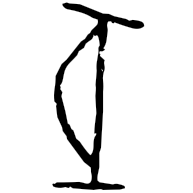 甲骨文 oracle bone · 商
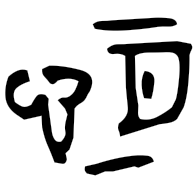 金文 bronze · 西周中期
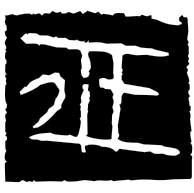 戰國文字 Warring States · 戰國晚期.晉
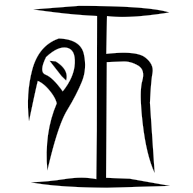 篆文 seal
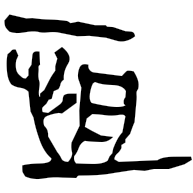 隸書 clerical · 秦
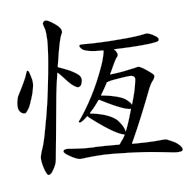 楷書 regular
Legge's note (1882)
Legge's title for the hexagram: perseverance (long continuance).
XXXII. The subject of this hexagram may be given as perseverance in well doing, or in continuously acting out the law of one’s being. The sixth Appendix makes it a sequel of the previous figure. As that treats, it is said, of the relation between husband and wife, so this treats of the continuous observance of their respective duties. Hsien, we saw, is made up of Kăn, the symbol of the youngest son, and Tui, the symbol of the youngest daughter, attraction and influence between the sexes being strongest in youth. Hăng consists of Sun, ‘the oldest daughter,’ and Kăn, the oldest son. The couple are more staid. The wife occupies the lower place; and the relation between them is marked by her submission. This is sound doctrine, especially from a Chinese point of view; but I doubt whether such application of his teaching was in the mind of king Wăn. Given two parties, an inferior and superior in correlation. If both be continuously observant of what is correct, the inferior being also submissive, and the superior firm, good fortune and progress may be predicated of their course. Line 1 has a proper correlate in 4; but between them are two strong lines; and it is itself weak. These two conditions are against its subject receiving much help from the subject of 4. He should be quiet, and not forward for action. Line 2 is strong, but in the place of a weak line. Its position, however, being central, and its subject holding fast to the due mean, the unfavourable condition of an even place is more than counteracted. Line 3 is strong, and in its proper place; but being beyond the centre of the trigram, its subject is too strong, and coming under the attraction of his correlate in 6, he is supposed to be ready to abandon his place and virtue. He may try to be firm and correct, but circumstances are adverse to him. Line 4 is strong in the place of a weak line, and suggests the symbolism of the duke of Kâu. The weak 5th line responds to the strong 2nd, and may be supposed to represent a wife conscious of her weakness, and docilely submissive; which is good. A husband, however, and a man generally, has to assert himself, and lay down the rule of what is right. In line 6 the principle of perseverance has run its course; the motive power of Kăn is exhausted. The line itself is weak. The violent efforts of its subject can only lead to evil.
Sources
- Chinese text: 周易, 維基文庫, page (revision 10646486); the text is public domain, the site's edits CC BY-SA 4.0.
- English: James Legge, The Yî King, Sacred Books of the East vol. XVI, Oxford 1882 (public domain), where this hexagram is “Hăng”.
- Glyph images: 小學堂 字形演變, Academia Sinica (CC0 1.0).
- Pinyin: Unihan (Unicode License v3) with this site's readings for the classical cases. English gloss, relations, the idiom glosses, the English of the chronicle passages and the plain reading: this site.