- The 64
- Hexagram 34
34 大壯 Great Strength
乾 Heaven below, 震 Thunder above
Thunder high above heaven: great strength, four strong lines pushing up. The text gives two characters of counsel, 利貞, firmness is advantageous, and the lines are a ram at a fence.
Tap a line of the figure to see where it leads when it changes. Cast for a question of your own. New here? What the I Ching is, coming from tarot.
This site's reading
卦辭 利貞: advantageous to be firm and correct. The whole Judgment. When strength is great, the only question the text asks is whether it is used rightly.
彖 The commentary: the great is strong; firm and moving, hence strong. Great strength with firmness: the great is correct. In what is correct and great, the nature of heaven and earth can be seen.
大象 Thunder above heaven: the noble person does not tread where propriety does not go (非禮弗履). Strength is bounded by rite, not by opposition.
爻 The lines: strength in the toes, going brings evil, sincerity; firm and good; a small man uses strength, a noble one uses the net of restraint, firmness and peril, the ram butts the fence and tangles its horns; firm and good, regret gone, the fence breaks and the horns are free, strength in the axle of a great cart; losing the ram in the field with ease, no regret; and at the top the ram butts the fence, can neither back out nor go through, nothing advantageous, but hardship then good. The ram is the whole hexagram: strength that forgets it can stop.
If your question is about
- A relationship
- Strength that can neither back out nor go through (line 6) is the warning; the noble person uses restraint where the small man uses force.
- Work
- Great strength, bounded by what is proper (the Image). Line 4 is the good use: the fence gives way and the cart's axle holds.
- A decision
- Firmness, not force. Strength in the toes (line 1) is going too early; the top line is strength stuck.
- No line changing
- Strength as a state, held under propriety. The ram is not yet at the fence; keep it that way.
Written from the text above and checked against it by Lun (2026-10-24). It is a way of reading the hexagram, not a prediction.
The text, with Legge
Judgment 卦辭
大壯:利貞。
Tâ Kwang indicates that (under the conditions which it symbolises) it will be advantageous to be firm and correct. (Legge, 1882)
Commentary on the Judgment 彖
大壯,大者壯也。剛以動,故壯。大壯利貞;大者正也。正大而天地之情可見矣!
The Image 大象
雷在天上,大壯;君子以非禮弗履。
The six lines
Line 1 初九
壯于趾,征凶,有孚。
The first line, undivided, shows its subject manifesting his strength in his toes. But advance will lead to evil,—most certainly. (Legge, 1882)
The Image 小象
壯于趾,其孚窮也。
Changing, this line leads to 32 恒 Héng.
Line 2 九二
貞吉。
The second line, undivided, shows that with firm correctness there will be good fortune. (Legge, 1882)
The Image 小象
九二貞吉,以中也。
Changing, this line leads to 55 豐 Fēng.
Line 3 九三
小人用壯,君子用罔,貞厲。羝羊觸藩,羸其角。
The third line, undivided, shows, in the case of a small man, one using all his strength; and in the case of a superior man, one whose rule is not to do so. Even with firm correctness the position would be perilous. (The exercise of strength in it might be compared to the case of) a ram butting against a fence, and getting his horns entangled. (Legge, 1882)
The Image 小象
小人用壯,君子罔也。
Changing, this line leads to 54 歸妹 Guī Mèi.
Line 4 九四
貞吉悔亡,藩決不羸,壯于大轝之腹。
The fourth line, undivided, shows (a case in which) firm correctness leads to good fortune, and occasion for repentance disappears. (We see) the fence opened without the horns being entangled. The strength is like that in the wheel-spokes of a large waggon. (Legge, 1882)
The Image 小象
藩決不羸,尚往也。
Changing, this line leads to 11 泰 Tài.
Line 5 六五
喪羊于易,无悔。
The fifth line, divided, shows one who loses his ram(-like strength) in the ease of his position. (But) there will be no occasion for repentance. (Legge, 1882)
The Image 小象
喪羊于易,位不當也。
Changing, this line leads to 43 夬 Guài.
Line 6 上六
羝羊觸藩,不能退,不能遂,无攸利,艱則吉。
The sixth line, divided, shows (one who may be compared to) the ram butting against the fence, and unable either to retreat, or to advance as he would fain do. There will not be advantage in any respect; but if he realise the difficulty (of his position), there will be good fortune. (Legge, 1882)
The Image 小象
不能退,不能遂,不詳也。艱則吉,咎不長也。
Changing, this line leads to 14 大有 Dà Yǒu.
In the calendar
In the Han dynasty's 卦氣 tradition, which lays the hexagrams over the year, 大壯 is one of the twelve sovereign hexagrams 消息卦: it governs the month that begins at 春分, spring equinox, and runs until 穀雨 (grain rain), the second month of the traditional year, the month of 卯. Four yang lines; the 'great strength' of spring.
The calendar is a later tradition about the hexagrams, not part of the text above.
Related hexagrams
Where the name comes from
大
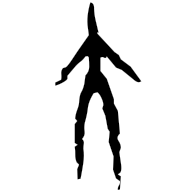 甲骨文 oracle bone · 商
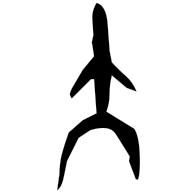 金文 bronze · 西周早期
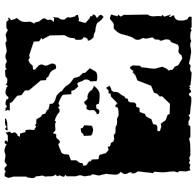 戰國文字 Warring States · 戰國.齊
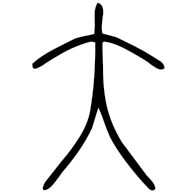 篆文 seal
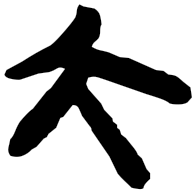 隸書 clerical · 秦
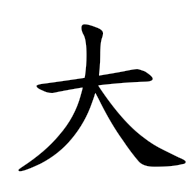 楷書 regular
壯
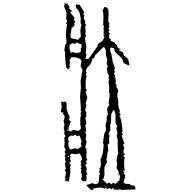 金文 bronze · 戰國早期.楚
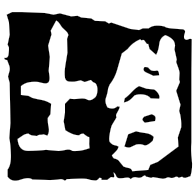 戰國文字 Warring States · 戰國.燕
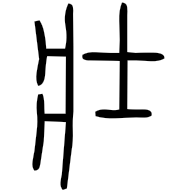 篆文 seal
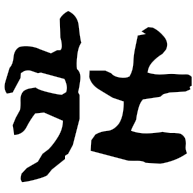 隸書 clerical · 西漢
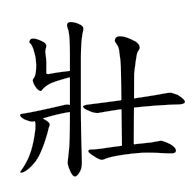 楷書 regular
Legge's note (1882)
Legge's title for the hexagram: .
XXXIV. The strong lines predominate in Tâ Kwang. It suggested to king Wăn a state or condition of things in which there was abundance of strength and vigour. Was strength alone enough for the conduct of affairs? No. He saw also in the figure that which suggested to him that strength should be held in subordination to the idea of right, and exerted only in harmony with it. This is the lesson of the hexagram, as sententiously expressed in the Thwan. Line 1 is strong, in its correct place, and also the first line in Khien, the hexagram of strength, and the first line in Tâ Kwang. The idea of the figure might seem to be concentrated in it; and hence we have it symbolised by ‘strength in the toes,’ or ‘advancing.’ But such a measure is too bold to be undertaken by one in the lowest place, and moreover there is no proper correlate in 4. Hence comes the evil auspice. Line 2 is strong, but the strength is tempered by its being in an even place, instead of being excited by it, as might be feared. Then the place is that in the centre. With firm correctness there will be good fortune. Line 3 is strong, and in its proper place. It is at the top moreover of Khien. A small man so symbolled will use his strength to the utmost; but not so the superior man. For him the position is beyond the safe middle, and he will be cautious; and not injure himself, like the ram, by exerting his strength. Line 4 is still strong, but in the place of a weak line; and this gives occasion to the cautions with which the symbolism commences. The subject of the line going forward thus cautiously, his strength will produce good effects, such as are described. Line 5 is weak, and occupies a central place. Its subject will cease therefore to exert his strength; but this hexagram does not forbid the employment of strength, but would only control and direct it. All that is said about him is that he will give no occasion for repentance. Line 6 being at the top of Kăn, the symbol of movement, and at the top of Tâ Kwang, its subject may be expected to be active in exerting his strength; and through his weakness, the result would be as described. But he becomes conscious of his weakness, reflects and rests, and good fortune results, as he desists from the prosecution of his unwise efforts.
Sources
- Chinese text: 周易, 維基文庫, page (revision 10646529); the text is public domain, the site's edits CC BY-SA 4.0.
- English: James Legge, The Yî King, Sacred Books of the East vol. XVI, Oxford 1882 (public domain), where this hexagram is “Tâ Kwang”.
- Glyph images: 小學堂 字形演變, Academia Sinica (CC0 1.0).
- Pinyin: Unihan (Unicode License v3) with this site's readings for the classical cases. English gloss, relations, the idiom glosses, the English of the chronicle passages and the plain reading: this site.