- The 64
- Hexagram 43
43 夬 Resolve
乾 Heaven below, 兌 Lake above
Five strong lines pushing out the last weak one at the top: resolve, the decisive break. The text says to declare it in the king's court, to call out sincerely with a sense of danger, and not to take up arms.
Tap a line of the figure to see where it leads when it changes. Cast for a question of your own. New here? What the I Ching is, coming from tarot.
This site's reading
卦辭 揚于王庭,孚號,有厲,告自邑,不利即戎,利有攸往: proclaim it in the royal court; call out in sincerity; there is danger; announce it from your own town; not advantageous to go to arms; advantageous to go. Resolve is done in the open and without weapons.
彖 The commentary: 夬 is to decide, the firm deciding against the yielding; strong and pleased, decisive and in harmony. The sincere call with danger is what makes the peril shine; not going to arms, because force would exhaust what is honoured; going somewhere is the firm growing to its end.
大象 The lake risen to heaven: the noble person gives benefits to those below and shuns resting on his virtue. Resolve that keeps the gains is what it meant to remove.
爻 The lines: strength in the front of the foot, going and not winning is blame; a cry of alarm, arms in the night, no need to worry; strength in the cheekbones, evil, the noble person resolute alone, walking in the rain, wet and resented, no blame; walking haltingly on skinned buttocks, led like a sheep the regret would vanish, but the words are not believed; purslane uprooted resolutely, walking the middle, no blame; and at the top no call, and in the end evil. The lesson is how, not whether.
If your question is about
- A relationship
- A decisive break, made openly and without weapons (the Judgment). Resolve alone in the rain (line 3) is bearable; strength in the face is not.
- Work
- Declare it in court, not in the field. Give the gains downward (the Image); resting on your virtue makes you the next weak line.
- A decision
- Decide, in the open, with a sense of danger and without arms. Do not go in on the front of the foot (line 1).
- No line changing
- Resolve as a state: the last weak line still there. Keep calling out sincerely; the top line's silence is the end to avoid.
Written from the text above and checked against it by Lun (2026-10-24). It is a way of reading the hexagram, not a prediction.
The text, with Legge
Judgment 卦辭
夬:揚于王庭,孚號,有厲,告自邑,不利即戎,利有攸往。
Kwâi requires (in him who would fulfil its meaning) the exhibition (of the culprit’s guilt) in the royal court, and a sincere and earnest appeal (for sympathy and support), with a consciousness of the peril (involved in cutting off the criminal). He should (also) make announcement in his own city, and show that it will not be well to have recourse at once to arms. (In this way) there will be advantage in whatever he shall go forward to. (Legge, 1882)
Commentary on the Judgment 彖
夬,決也,剛決柔也。健而說,決而和,揚于王庭,柔乘五剛也。孚號有厲,其危乃光也。告自邑,不利即戎,所尚乃窮也。利有攸往,剛長乃終也。
The Image 大象
澤上于天,夬;君子以施祿及下,居德則忌。
The six lines
Line 1 初九
壯于前趾,往不勝為咎。
The first line, undivided, shows its subject in (the pride of) strength advancing with his toes. He goes forward, but will not succeed. There will be ground for blame. (Legge, 1882)
The Image 小象
不勝而往,咎也。
Changing, this line leads to 28 大過 Dà Guò.
Line 2 九二
惕號,莫夜有戎,勿恤。
The second line, undivided, shows its subject full of apprehension and appealing (for sympathy and help). Late at night hostile measures may be (taken against him), but he need not be anxious about them. (Legge, 1882)
The Image 小象
莫夜有戎,得中道也。
Changing, this line leads to 49 革 Gé.
Line 3 九三
壯于頄,有凶。君子夬夬,獨行遇雨,若濡有慍,无咎。
The third line, undivided, shows its subject (about to advance) with strong (and determined) looks. There will be evil. (But) the superior man, bent on cutting off (the criminal), will walk alone and encounter the rain, (till he be hated by his proper associates) as if he were contaminated (by the others). (In the end) there will be no blame against him. (Legge, 1882)
The Image 小象
君子夬夬,終无咎也。
Changing, this line leads to 58 兌 Duì.
Line 4 九四
臀无膚,其行次且。牽羊悔亡,聞言不信。
The fourth line, undivided, shows one from whose buttocks the skin has been stripped, and who walks slowly and with difficulty. (If he could act) like a sheep led (after its companions), occasion for repentance would disappear. But though he hear these words, he will not believe them. (Legge, 1882)
The Image 小象
其行次且,位不當也。聞言不信,聰不明也。
Changing, this line leads to 5 需 Xū.
Line 5 九五
莧陸夬夬,中行无咎。
The fifth line, undivided, shows (the small men like) a bed of purslain, which ought to be uprooted with the utmost determination. (The subject of the line having such determination), his action, in harmony with his central position, will lead to no error or blame. (Legge, 1882)
The Image 小象
中行无咎,中未光也。
Changing, this line leads to 34 大壯 Dà Zhuàng.
Line 6 上六
无號,終有凶。
The sixth line, divided, shows its subject without any (helpers) on whom to call. His end will be evil. (Legge, 1882)
The Image 小象
无號之凶,終不可長也。
Changing, this line leads to 1 乾 Qián.
In the calendar
In the Han dynasty's 卦氣 tradition, which lays the hexagrams over the year, 夬 is one of the twelve sovereign hexagrams 消息卦: it governs the month that begins at 穀雨, grain rain, and runs until 小滿 (grain full), the third month of the traditional year, the month of 辰. Five yang push out the last yin at the top.
The calendar is a later tradition about the hexagrams, not part of the text above.
Related hexagrams
Where the name comes from
夬
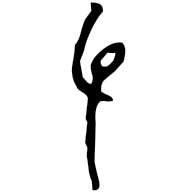 甲骨文 oracle bone · 商
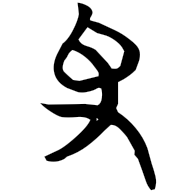 戰國文字 Warring States · 戰國.楚
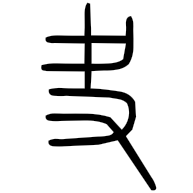 篆文 seal
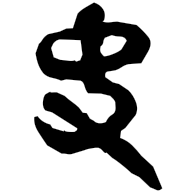 隸書 clerical · 秦
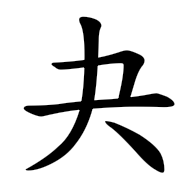 楷書 regular
Legge's note (1882)
Legge's title for the hexagram: .
XLIII. In Kwâi we have the hexagram of the third month, when the last remnant, cold and dark, of winter, represented by the sixth line, is about to disappear before the advance of the warm and bright days of the approaching summer. In the yin line at the top king Wăn saw the symbol of a small or bad man, a feudal prince or high minister, lending his power to maintain a corrupt government, or, it might be, a dynasty that was waxen old and ready to vanish away; and in the five undivided lines he saw the representatives of good order, or, it might be, the dynasty which was to supersede the other. This then is the subject of the hexagram:—how bad men, statesmen corrupt and yet powerful, are to be put out of the way. And he who would accomplish the task must do so by the force of his character more than by force of arms, and by producing a general sympathy on his side. The Thwan says that he must openly denounce the criminal in the court, seek to awaken general sympathy, and at the same time go about his enterprise, conscious of its difficulty and danger. Among his own adherents, moreover, as if it were in his own city, he must make it understood how unwillingly he takes up arms. Then let him go forward, and success will attend him. Line 1 is strong, the first line of that trigram, which expresses the idea of strength. But it is in the lowest place. The stage of the enterprise is too early, and the preparation too small to make victory certain. Its subject had better not take the field. Line 2 is strong, and central, and its subject is possessed with the determination to do his part in the work of removal. But his eagerness is tempered by his occupancy of an even place; and he is cautious, and no attempts, however artful, to harm him will take effect. Line 3 is strong, and its subject displays his purpose too eagerly. Being beyond the central position, moreover, gives an indication of evil. Lines 3 and 6 are also proper correlates; and, as elsewhere in the Yî, the meeting of yin and yang lines is associated with falling rain. The subject of 3, therefore, communicates with 6, in a way that annoys his associates; but nevertheless he commits no error, and, in the end, incurs no blame. Line 4 is not in the centre, nor in an odd place, appropriate to it as undivided. Its subject therefore will not be at rest, nor able to do anything to accomplish the idea of the hexagram. He is symbolised by a culprit, who, according to the ancient and modern custom of Chinese courts, has been bastinadoed till he presents the appearance in the Text. Alone he can do nothing; if he could follow others, like a sheep led along, he might accomplish something, but he will not listen to advice. Purslain grows in shady places, and hence we find it here in close contiguity to the topmost line, which is yin. As 5 is the ruler’s seat, evil may come to him from such contiguity, and strenuous efforts must be made to prevent such an evil. The subject of the line, the ruler in the central place, will commit no error. It must be allowed that the symbolism in this line is not easily managed. The subject of the 6th line, standing alone, may be easily disposed of.
Sources
- Chinese text: 周易, 維基文庫, page (revision 2405003); the text is public domain, the site's edits CC BY-SA 4.0.
- English: James Legge, The Yî King, Sacred Books of the East vol. XVI, Oxford 1882 (public domain), where this hexagram is “Kwâi”.
- Glyph images: 小學堂 字形演變, Academia Sinica (CC0 1.0).
- Pinyin: Unihan (Unicode License v3) with this site's readings for the classical cases. English gloss, relations, the idiom glosses, the English of the chronicle passages and the plain reading: this site.