- The 64
- Hexagram 45
45 萃 Gathering
坤 Earth below, 兌 Lake above
The lake gathered above the earth: gathering, people assembled. The text says the king goes to the temple, that the great person should be seen, that a great offering is good, and that there is somewhere to go.
Tap a line of the figure to see where it leads when it changes. Cast for a question of your own. New here? What the I Ching is, coming from tarot.
This site's reading
卦辭 王假有廟,利見大人,亨。利貞。用大牲吉,利有攸往: the king arrives at the temple; advantageous to see the great person; it gets through; firmness advantageous; a great sacrifice is good; advantageous to go. Gathering is held together by a centre, a rite and a leader.
彖 The commentary: 萃 is to collect; compliant and pleased, firm in the centre and answered, hence gathering. The king at the temple brings the filial offering; seeing the great person gathers by what is correct; the great sacrifice follows heaven's mandate. See what is gathered, and the nature of all things can be seen.
大象 The lake above the earth: the noble person puts the weapons in order and guards against the unforeseen. A crowd is a risk as well as a strength.
爻 The lines: sincerity that does not last, confusion and then gathering, a cry and a handful of laughter, no worry, going is no blame; drawn forward, good, no blame, sincerity makes even a small offering fitting; gathering with sighs, nothing advantageous, going is no blame, small regret; greatly good, no blame; gathering in the place of dignity, no blame, not trusted, great and lasting firmness ends regret; and at the top sighs and tears, no blame. The gathering has a centre (line 5) and edges where people weep.
If your question is about
- A relationship
- A coming-together with a centre; sincerity makes even a small offering fit (line 2). Those at the edge sigh and are not blamed.
- Work
- Gather around a rite and a leader; see the great person. Put the weapons in order (the Image): a crowd needs guarding.
- A decision
- Go, toward the centre; the great offering is worth it. Firmness and lasting sincerity (line 5) make the gathering trust you.
- No line changing
- Gathering that holds: the lake stays above the earth. Guard against the unforeseen; the sighs at the edges are part of it.
Written from the text above and checked against it by Lun (2026-10-24). It is a way of reading the hexagram, not a prediction.
The text, with Legge
Judgment 卦辭
萃:王假有廟,利見大人,亨。利貞。用大牲吉,利有攸往。
In (the state denoted by) Ȝhui, the king will repair to his ancestral temple. It will be advantageous (also) to meet with the great man; and then there will be progress and success, though the advantage must come through firm correctness. The use of great victims will conduce to good fortune; and in whatever direction movement is made, it will be advantageous. (Legge, 1882)
Commentary on the Judgment 彖
萃,聚也;順以說,剛中而應,故聚也。王假有廟,致孝享也。利見大人亨,聚以正也。用大牲吉,利有攸往,順天命也。觀其所聚,而天地萬物之情可見矣。
The Image 大象
澤上于地,萃;君子以除戎器,戒不虞。
The six lines
Line 1 初六
有孚不終,乃亂乃萃,若號一握為笑,勿恤,往无咎。
The first line, divided, shows its subject with a sincere desire (for union), but unable to carry it out, so that disorder is brought into the sphere of his union. If he cry out (for help to his proper correlate), all at once (his tears) will give place to smiles. He need not mind (the temporary difficulty); as he goes forward, there will be no error. (Legge, 1882)
The Image 小象
乃亂乃萃,其志亂也。
Changing, this line leads to 17 隨 Suí.
Line 2 六二
引吉,无咎,孚乃利用禴。
The second line, divided, shows its subject led forward (by his correlate). There will be good fortune, and freedom from error. There is entire sincerity, and in that case (even the small offerings of) the vernal sacrifice are acceptable. (Legge, 1882)
The Image 小象
引吉无咎,中未變也。
Changing, this line leads to 47 困 Kùn.
Line 3 六三
萃如,嗟如,无攸利,往无咎,小吝。
The third line, divided, shows its subject striving after union and seeming to sigh, yet nowhere finding any advantage. If he go forward, he will not err, though there may be some small cause for regret. (Legge, 1882)
The Image 小象
往无咎,上巽也。
Changing, this line leads to 31 咸 Xián.
Line 4 九四
大吉,无咎。
The fourth line, undivided, shows its subject in such a state that, if he be greatly fortunate, he will receive no blame. (Legge, 1882)
The Image 小象
大吉无咎,位不當也。
Changing, this line leads to 8 比 Bǐ.
Line 5 九五
萃有位,无咎。匪孚,元永貞,悔亡。
The fifth line, undivided, shows the union (of all) under its subject in the place of dignity. There will be no error. If any do not have confidence in him, let him see to it that (his virtue) be great, long-continued, and firmly correct, and all occasion for repentance will disappear. (Legge, 1882)
The Image 小象
萃有位,志未光也。
Changing, this line leads to 16 豫 Yù.
Line 6 上六
齎資涕洟,无咎。
The topmost line, divided, shows its subject sighing and weeping; but there will be no error. (Legge, 1882)
The Image 小象
齎咨涕洟,未安上也。
Changing, this line leads to 12 否 Pǐ.
Related hexagrams
Where the name comes from
萃
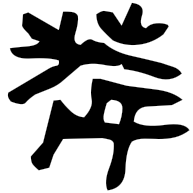 金文 bronze · 戰國晚期.燕
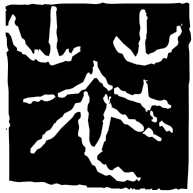 戰國文字 Warring States · 戰國.晉
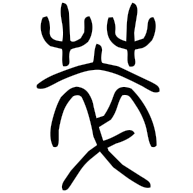 篆文 seal
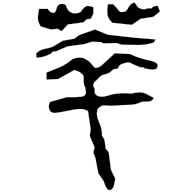 隸書 clerical · 西漢
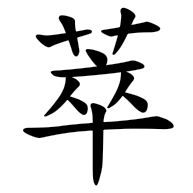 楷書 regular
Legge's note (1882)
Legge's title for the hexagram: collecting together.
XLV. Ȝhui denotes collecting together, or things so collected; and hence this hexagram concerns the state of the kingdom when a happy union prevails between the sovereign and his ministers, between high and low; and replies in a vague way to the question how this state is to be preserved; by the influence of religion, and the great man, who is a sage upon the throne. He, ‘the king,’ will repair to his ancestral temple, and meet in spirit there with the spirits of his ancestors. Whatever he does, being correct and right, will succeed. His religious services will be distinguished by their dignity and splendour. His victims will be the best that can be obtained, and other things will be in harmony with them. Line 1 is weak, and in the place of a strong line. It has a proper correlate in 4, but is separated from him by the intervention of two weak lines. The consequence of these things is supposed to be expressed in the first part of the symbolism; but the subject of the line is possessed by the desire for union, which is the theme of the hexagram. Calling out to his correlate for help, he obtains it, and his sorrow is turned into joy. Line 2 is in its proper place, and responds to the strong ruler in 5, who encourages and helps the advance of its subject. He possesses also the sincerity, proper to him in his central position; and though he were able to offer only the sacrifice of the spring, small compared with the fulness of the sacrifices in summer and autumn, it would be accepted. Line 3 is weak, in the place of a strong line, and advanced from the central place. The topmost line, moreover, is no proper correlate. But its subject is possessed by the desire for union; and though 2 and 4 decline to associate with him, he presses on to 6, which is also desirous of union. That common desire brings them together, notwithstanding 3 and 6 are both divided lines; and with difficulty the subject of 3 accomplishes his object. [But that an ordinary rule for interpreting the lineal indications may be thus overruled by extraordinary considerations shows how much of fancy there is in the symbolism or in the commentaries on it.] Line 4 has its correlate in 1, and is near to the ruling line in 5. We may expect a good auspice for it; but its being strong in an odd place, calls for the caution which is insinuated. Line 5 is strong, central, and in its correct position. Through its subject there may be expected the full realisation of the idea of the hexagram. Line 6, weak, and at the extremity of the figure, is still anxious for union; but he has no proper correlate, and all below are united in 5. Its subject mourns his solitary condition; and his good feeling will preserve him from error and blame.
Sources
- Chinese text: 周易, 維基文庫, page (revision 10647546); the text is public domain, the site's edits CC BY-SA 4.0.
- English: James Legge, The Yî King, Sacred Books of the East vol. XVI, Oxford 1882 (public domain), where this hexagram is “Ȝhui”.
- Glyph images: 小學堂 字形演變, Academia Sinica (CC0 1.0).
- Pinyin: Unihan (Unicode License v3) with this site's readings for the classical cases. English gloss, relations, the idiom glosses, the English of the chronicle passages and the plain reading: this site.