- The 64
- Hexagram 26
26 大畜 Great Restraint
乾 Heaven below, 艮 Mountain above
Heaven held inside a mountain: great restraint, strength stored. The text says firmness is advantageous, that it is good not to eat at home, and that the great stream can be crossed.
Tap a line of the figure to see where it leads when it changes. Cast for a question of your own. New here? What the I Ching is, coming from tarot.
This site's reading
卦辭 利貞,不家食吉,利涉大川: advantageous to be firm; not eating at home is good, that is, take service and be fed at court rather than live on one's own; advantageous to cross the great stream. What is stored is meant to be used.
彖 The commentary: firm, strong, solid, substantial, shining, renewing its virtue daily; the firm above honours the worthy; able to stop the strong, which is great correctness. Not eating at home nourishes the worthy; crossing the stream answers heaven.
大象 Heaven within the mountain: the noble person learns much of former words and past deeds, to store up virtue. Restraint here is a library, not a cage.
爻 The lines: danger, better to stop; the carriage loses its axle straps; good horses in pursuit, hard firmness is good, daily practice of chariot and guard, then somewhere to go; the young bull with the board on its horns, greatly good; the gelded boar's tusks, good; and at the top carrying heaven's highway, it gets through. The strength is checked low down (the strap, the horn-board, the tusks) and released high up.
If your question is about
- A relationship
- Strength stored rather than spent; the young bull's board (line 4) is restraint before harm, not after. Patience here is good.
- Work
- Take the post, do not stay home (the Judgment). Store learning, hold the strength until the top line opens the road.
- A decision
- Stop first (line 1), practise daily (line 3), then go; the crossing is allowed once the restraint has done its work.
- No line changing
- Restraint as a state: heaven inside the mountain. Keep learning former words and deeds; the storing is the point.
Written from the text above and checked against it by Lun (2026-10-24). It is a way of reading the hexagram, not a prediction.
The text, with Legge
Judgment 卦辭
大畜:利貞,不家食吉,利涉大川。
Under the conditions of Tâ Khû it will be advantageous to be firm and correct. (If its subject do not seek to) enjoy his revenues in his own family (without taking service at court), there will be good fortune. It will be advantageous for him to cross the great stream. (Legge, 1882)
Commentary on the Judgment 彖
大畜,剛健篤實輝光,日新其德,剛上而尚賢。能止健,大正也。不家食吉,養賢也。利涉大川,應乎天也。
The Image 大象
天在山中,大畜;君子以多識前言往行,以畜其德。
The six lines
Line 1 初九
有厲利已。
The first line, undivided, shows its subject in a position of peril. It will be advantageous for him to stop his advance. (Legge, 1882)
The Image 小象
有厲利已,不犯災也。
Changing, this line leads to 18 蠱 Gǔ.
Line 2 九二
輿說輹。
The second line, undivided, shows a carriage with the strap under it removed. (Legge, 1882)
The Image 小象
輿說輹,中无尤也。
Changing, this line leads to 22 賁 Bì.
Line 3 九三
良馬逐,利艱貞,吉。日閑輿衛,利有攸往。
The third line, undivided, shows its subject urging his way with good horses. It will be advantageous for him to realise the difficulty (of his course), and to be firm and correct, exercising himself daily in his charioteering and methods of defence; then there will be advantage in whatever direction he may advance. (Legge, 1882)
The Image 小象
利有攸往,上合志也。
Changing, this line leads to 41 損 Sǔn.
Line 4 六四
童牛之告,元吉。
The fourth line, divided, shows the young bull, (and yet) having the piece of wood over his horns. There will be great good fortune. (Legge, 1882)
The Image 小象
六四元吉,有喜也。
Changing, this line leads to 14 大有 Dà Yǒu.
Line 5 六五
豶豕之牙,吉。
The fifth line, divided, shows the teeth of a castrated hog. There will be good fortune. (Legge, 1882)
The Image 小象
六五之吉,有慶也。
Changing, this line leads to 9 小畜 Xiǎo Chù.
Line 6 上九
何天之衢,亨。
The sixth line, undivided, shows its subject (as) in command of the firmament of heaven. There will be progress. (Legge, 1882)
The Image 小象
何天之衢,道大行也。
Changing, this line leads to 11 泰 Tài.
Related hexagrams
Where the name comes from
大
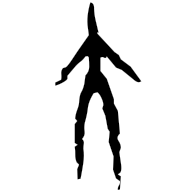 甲骨文 oracle bone · 商
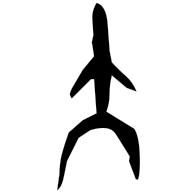 金文 bronze · 西周早期
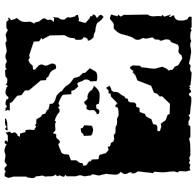 戰國文字 Warring States · 戰國.齊
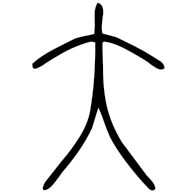 篆文 seal
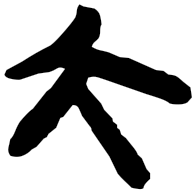 隸書 clerical · 秦
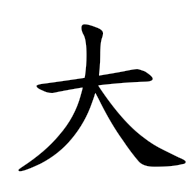 楷書 regular
畜
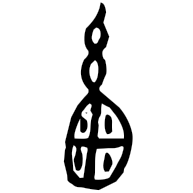 甲骨文 oracle bone · 商
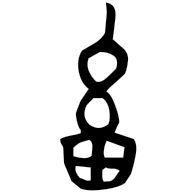 金文 bronze · 春秋中期
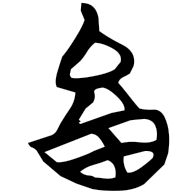 戰國文字 Warring States · 戰國.楚
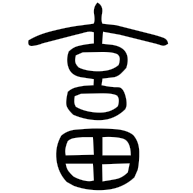 篆文 seal
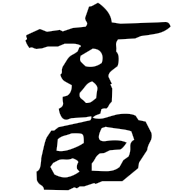 隸書 clerical · 秦
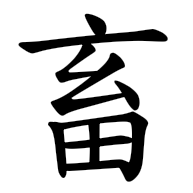 楷書 regular
Legge's note (1882)
Legge's title for the hexagram: the Great Accumulation.
XXVI. Khû has two meanings. It is the symbol of restraint, and of accumulation. What is repressed and restrained accumulates its strength and increases its volume. Both these meanings are found in the treatise on the Thwan; the exposition of the Great Symbolism has for its subject the accumulation of virtue. The different lines are occupied with the repression or restraint of movement. The first three lines receive that repression, the upper three exercise it. The accumulation to which all tends is that of virtue; and hence the name of Tâ Khû, ‘the Great Accumulation.’ What the Thwan teaches, is that he who goes about to accumulate his virtue must be firm and correct, and may then, engaging in the public service, enjoy the king’s grace, and undertake the most difficult enterprises. Line 1 is subject to the repression of 4, which will be increased if he try to advance. It is better for him to halt. Line 2 is liable to the repression of 5, and stops its advance of itself, its subject having the wisdom to do so through its position in the central place. The strap below, when attached to the axle, made the carriage stop; he himself acts that part. Line 3 is the last of Khien, and responds to the sixth line, the last of Kăn, above. But as they are both strong, the latter does not exert its repressive force. They advance rapidly together; but the position is perilous for 3. By firmness and caution, however, its subject will escape the peril, and the issue will be good. The young bull in line 4 has not yet got horns. The attaching to their rudiments the piece of wood to prevent him from goring is an instance of extraordinary precaution; and precaution is always good. A boar is a powerful and dangerous animal. Let him be castrated, and though his tusks remain, he cares little to use them. Here line 5 represents the ruler in the hexagram, whose work is to repress the advance of evil. A conflict with the subject of the strong second line in its advance would be perilous; but 5, taking early precaution, reduces it to the condition of the castrated pig. Not only is there no evil, but there is good fortune. The work of repression is over, and the strong subject of line 6 has now the amplest scope to carry out the idea of the hexagram in the accumulation of virtue.
Sources
- Chinese text: 周易, 維基文庫, page (revision 10646304); the text is public domain, the site's edits CC BY-SA 4.0.
- English: James Legge, The Yî King, Sacred Books of the East vol. XVI, Oxford 1882 (public domain), where this hexagram is “Tâ Khû”.
- Glyph images: 小學堂 字形演變, Academia Sinica (CC0 1.0).
- Pinyin: Unihan (Unicode License v3) with this site's readings for the classical cases. English gloss, relations, the idiom glosses, the English of the chronicle passages and the plain reading: this site.