- The 64
- Hexagram 8
8 比 Alliance
坤 Earth below, 坎 Water above
Water on the earth, gathering: alliance, drawing close. The text says it is good, that the one who joins should first examine himself, and that the latecomer meets evil.
Tap a line of the figure to see where it leads when it changes. Cast for a question of your own. New here? What the I Ching is, coming from tarot.
This site's reading
卦辭 比 is good. Divine again (原筮): great, lasting, firm, without blame. Those unsettled come; the one who comes last, 後夫, meets evil. Alliance is open, and it closes.
彖 The commentary: 比 is assistance, those below following. Re-examining oneself is the firm line in the centre; the unsettled arriving is above and below responding; the latecomer's evil is his way exhausted.
大象 Water on the earth: the former kings set up the ten thousand states and drew the lords close. Alliance is built by the one at the centre reaching out, not by waiting.
爻 The lines: sincerity in joining, a full jar, and other good coming unlooked for; joining from within, firm and good; joining with the wrong people (匪人); joining with one outside, firm and good; the illustrious alliance, the king who hunts on three sides and lets the game ahead escape, the townspeople unwarned and unafraid, good; and at the top joining with no head, evil. The fifth line is the model: a leader who does not surround.
If your question is about
- A relationship
- Draw close from within and with sincerity (lines 1 and 2); not with the wrong people (3). Arriving last, or without a head, fails.
- Work
- An alliance is forming; check your own fitness first, then join early. The good leader leaves an open side, and no one is forced.
- A decision
- Join, and join now; the latecomer is the one line that fails. Make sure there is a head to it.
- No line changing
- Alliance as a standing state: belonging that asks sincerity and gives rest. Nothing to force; keep the jar full.
Written from the text above and checked against it by Lun (2026-10-24). It is a way of reading the hexagram, not a prediction.
The text, with Legge
Judgment 卦辭
比:吉。原筮元永貞,无咎。不寧方來,後夫凶。
Pî indicates that (under the conditions which it supposes) there is good fortune. But let (the principal party intended in it) re-examine himself, (as if) by divination, whether his virtue be great, unintermitting, and firm. If it be so, there will be no error. Those who have not rest will then come to him; and with those who are (too) late in coming it will be ill. (Legge, 1882)
Commentary on the Judgment 彖
比,吉也。比,輔也,下順從也。原筮,元永貞,无咎,以剛中也。不寧方來,上下應也。後夫凶,其道窮也。
The Image 大象
地上有水,比;先王以建萬國,親諸侯。
The six lines
Line 1 初六
有孚,比之,无咎。有孚盈缶,終來有它,吉。
The first line, divided, shows its subject seeking by his sincerity to win the attachment of his object. There will be no error. Let (the breast) be full of sincerity as an earthenware vessel is of its contents, and it will in the end bring other advantages. (Legge, 1882)
The Image 小象
比之初六,有它吉也。
Changing, this line leads to 3 屯 Zhūn.
Line 2 六二
比之自內,貞吉。
In the second line, divided, we see the movement towards union and attachment proceeding from the inward (mind). With firm correctness there will be good fortune. (Legge, 1882)
The Image 小象
比之自內,不自失也。
Changing, this line leads to 29 坎 Kǎn.
Line 3 六三
比之匪人。
In the third line, divided, we see its subject seeking for union with such as ought not to be associated with. (Legge, 1882)
The Image 小象
比之匪人,不亦傷乎!
Changing, this line leads to 39 蹇 Jiǎn.
Line 4 六四
外比之,貞吉。
In the fourth line, divided, we see its subject seeking for union with the one beyond himself. With firm correctness there will be good fortune. (Legge, 1882)
The Image 小象
外比於賢,以從上也。
Changing, this line leads to 45 萃 Cuì.
Line 5 九五
顯比。王用三敺,失前禽,邑人不誡,吉。
The fifth line, undivided, affords the most illustrious instance of seeking union and attachment. (We seem to see in it) the king urging his pursuit of the game (only) in three directions, and allowing the escape of all the animals before him, while the people of his towns do not warn one another (to prevent it). There will be good fortune. (Legge, 1882)
The Image 小象
顯比之吉,位正中也。舍逆取順,失前禽也。邑人不誡,上使中也。
Changing, this line leads to 2 坤 Kūn.
Line 6 上六
比之无首,凶。
In the topmost line, divided, we see one seeking union and attachment without having taken the first step (to such an end). There will be evil. (Legge, 1882)
The Image 小象
比之无首,无所終也。
Changing, this line leads to 20 觀 Guān.
In history
The 左傳 and 國語, the chronicles of the sixth to fifth centuries BC, record real casts of the Changes and what came of them. 3 of them gave this hexagram.
661 BC: 畢萬, a man of 畢 seeking office in 晉
Asked: Should I take service in 晉? The stalks gave 3 屯 with line 1 changing, to 8 比.
吉。《屯》固、《比》入,吉孰大焉?其必蕃昌。辛廖 called it very auspicious: 屯 means holding firm and 比 means being received. He read the trigrams as a lord's hexagram, thunder turned to earth, chariot following horse, feet to stand on, elder brother to lead, mother to shelter, people to gather, and said the man's house would flourish and his descendants recover his standing.
That year 晉獻公 gave 畢萬 the city of 魏 as a fief. His descendants became the 魏 family, which in 403 BC was recognised as a state in its own right.
左傳 閔公元年, 維基文庫 (revision 2675997). Told in retrospect (初) under the year 畢萬 was enfeoffed. The diviner's reading is by trigram imagery, not the received line text.
540 BC: 孔成子, minister of 衛, on which son of 衛襄公 should succeed
Asked: Should 元 or his lame elder brother 縶 inherit 衛? The stalks gave 3 屯 with line 1 changing, to 8 比.
康叔名之.可謂長矣.孟非人也.將不列於宗.不可謂長.且其繇曰.利建侯.嗣吉.何建.建非嗣也.Two casts: whether 元 should hold 衛 gave 屯 unchanged; whether 縶 should be set up gave 屯 moving to 比. The scribe 史朝 read 元亨 and 'favourable to establish a lord' as the answer: establish, not inherit, so the younger boy, named by 康叔 in a dream, was the one. A lame man cannot serve at the altar.
孔成子 installed 元, who reigned as 衛靈公 from 534 to 493 BC.
左傳 昭公七年, 維基文庫 (revision 10445713). The entry carries the second cast, 屯之比; the first, 屯 with no moving line, is the same hexagram. 元 was born in the year 韓宣子 came to power in 晉, 540 BC, which is the year given; the passage stands under 535 BC. 利建侯 is in the received text of 屯.
530 BC: 南蒯, steward of the 季 family in 費, planning revolt
Asked: Will my plan succeed? The stalks gave 2 坤 with line 5 changing, to 8 比.
吾嘗學此矣.忠信之事則可.不然必敗.外彊内溫.忠也.和以率貞.信也.故曰黃裳元吉.南蒯 cast without stating his question and took the fifth line of 坤, 'yellow skirt, great fortune', as the best of signs. 子服惠伯 told him the line holds only for a loyal and honest undertaking: yellow is the centre's colour, the skirt the lower garment, and a disloyal man gets neither. The Changes cannot divine a crooked venture.
南蒯 took 費 into revolt against the 季 family. In 528 BC the people of 費 turned on him and he fled to 齊, where the duke called him a traitor to his face.
左傳 昭公十二年, 維基文庫 (revision 10445713). The line text 黃裳元吉 matches the received 坤 六五. The page writes 内 for 內.
The chronicles' diviners read from oracle texts of their own time; where their words match our clause text the note says so, and where they do not, it says that. None of this is a claim that the text foretold the event.
Related hexagrams
Where the name comes from
比
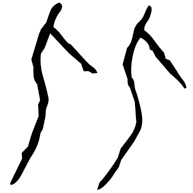 甲骨文 oracle bone · 商
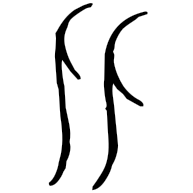 金文 bronze · 西周早期
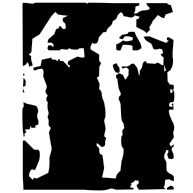 戰國文字 Warring States · 戰國.齊
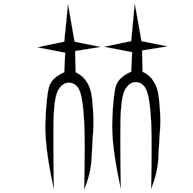 篆文 seal
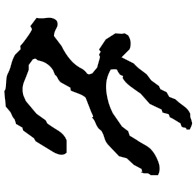 隸書 clerical · 秦
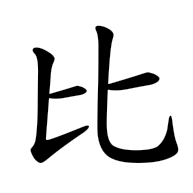 楷書 regular
Legge's note (1882)
Legge's title for the hexagram: union.
VIII. The idea of union between the different members and classes of a state, and how it can be secured, is the subject of the hexagram Pî. The whole line occupying the fifth place, or that of authority, in the hexagram, represents the ruler to whom the subjects of all the other lines offer a ready submission. According to the general rules for the symbolism of the lines, the second line is the correlate of the fifth; but all the other lines are here made subject to that fifth;—which is also a law of the Yî, according to the ‘Daily Lecture.’ To me it has the suspicious look of being made for the occasion. The harmony of union, therefore, is to be secured by the sovereign authority of one; but he is warned to see to it that his virtue be what will beseem his place, and subjects are warned not to delay to submit to him. Where does the ‘sincerity’ predicated of the subject of line 1 come from? The ‘earthenware vessel’ is supposed to indicate its plain, unadorned character; but there is nothing in the position and nature of the line, beyond the general idea in the figure, to suggest the attribute. Line 2 is the proper correlate of 5. Its position in the centre of the inner or lower trigram agrees with the movement of its subject as proceeding from the inward mind. Line 3 is weak, not in the centre, nor in its correct place. The lines above and below it are both weak. All these things are supposed to account for what is said on it. ‘The one beyond himself’ in line 4 is the ruler or king, who is the subject of 5, and with whom union ought to be sought. The divided line, moreover, is in a place proper to it. If its subject be firm and correct, there will be good fortune. The subject of line 5 is the king, who must be the centre of union. The ancient kings had their great hunting expeditions in the different seasons; and that of each season had its peculiar rules. But what is stated here was common to all. When the beating was completed, and the shooting was ready to commence, one side of the enclosure into which the game had been driven was left open and unguarded;—a proof of the royal benevolence, which did not want to make an end of all the game. So well known and understood is this benevolence of the model king of the hexagram, that all his people try to give it effect. Thus the union contemplated is shown to be characterised by mutual confidence and appreciation in virtue and benevolence. A weak line being in the 6th place, which is appropriate to it, its subject is supposed to be trying to promote union among and with the subjects of the lines below. It is too late. The time is past. Hence it is symbolised as ‘without a head,’ that is, as not having taken the first step, from which its action should begin, and go on to the end.
Sources
- Chinese text: 周易, 維基文庫, page (revision 10645543); the text is public domain, the site's edits CC BY-SA 4.0.
- English: James Legge, The Yî King, Sacred Books of the East vol. XVI, Oxford 1882 (public domain), where this hexagram is “Pî”.
- Glyph images: 小學堂 字形演變, Academia Sinica (CC0 1.0).
- Pinyin: Unihan (Unicode License v3) with this site's readings for the classical cases. English gloss, relations, the idiom glosses, the English of the chronicle passages and the plain reading: this site.