- The 64
- Hexagram 24
24 復 Return
震 Thunder below, 坤 Earth above
One strong line comes back at the bottom under five yielding ones: the turn of the year, the first step back. The text says it gets through, and that return is a road you travel more than once.
Tap a line of the figure to see where it leads when it changes. Cast for a question of your own. New here? What the I Ching is, coming from tarot.
This site's reading
卦辭 復:亨, return gets through. Going out and coming in without harm; friends arriving without blame. 反復其道,七日來復: turning back along one's own road, in seven days the return comes; and it is advantageous to have somewhere to go.
彖 The commentary says why it works: the firm line comes back (剛反), moving and proceeding by what is natural. Seven days is the sky's own rhythm, not a deadline. Its last sentence, 復其見天地之心乎, in Return we see the heart of heaven and earth: the point at which what was going down turns.
大象 Thunder inside the earth. The former kings closed the passes at the solstice; merchants did not travel; the ruler did not inspect the regions. The counsel is rest at the turning point. A return is protected by not rushing it.
爻 The lines grade returns: from not far off, before any regret, greatly good; a fine return; a repeated, anxious return, dangerous but blameless; turning back alone in the middle of the road; a return with firmness and no regret; and at the top a return gone astray (迷復), with disaster, defeat in arms, and ten years without recovery. The distance you have gone before turning is the whole difference.
If your question is about
- A relationship
- Something, or someone, is coming back. The text favours a return made early and gently; the sixth line is the return left too late.
- Work
- A turning point after a decline. Do not launch the moment you feel the turn; let it gather for seven days.
- A decision
- Turn back along your own road rather than cutting a new one. The best return is the one from not far off.
- No line changing
- The turn has begun and holds. Let it come; forcing it is the only mistake the text names.
Written from the text above and checked against it by Lun (2026-10-24). It is a way of reading the hexagram, not a prediction.
The text, with Legge
Judgment 卦辭
復:亨。出入无疾,朋來无咎。反復其道,七日來復,利有攸往。
Fû indicates that there will be free course and progress (in what it denotes). (The subject of it) finds no one to distress him in his exits and entrances; friends come to him, and no error is committed. He will return and repeat his (proper) course. In seven days comes his return. There will be advantage in whatever direction movement is made. (Legge, 1882)
Commentary on the Judgment 彖
復亨;剛反,動而以順行,是以出入无疾,朋來无咎。反復其道,七日來復,天行也。利有攸往,剛長也。復其見天地之心乎?
The Image 大象
雷在地中,復;先王以至日閉關,商旅不行,后不省方。
The six lines
Line 1 初九
不遠復,无祇悔,元吉。
The first line, undivided, shows its subject returning (from an error) of no great extent, which would not proceed to anything requiring repentance. There will be great good fortune. (Legge, 1882)
The Image 小象
不遠之復,以修身也。
Changing, this line leads to 2 坤 Kūn.
Line 2 六二
休復,吉。
The second line, divided, shows the admirable return (of its subject). There will be good fortune. (Legge, 1882)
The Image 小象
休復之吉,以下仁也。
Changing, this line leads to 19 臨 Lín.
Line 3 六三
頻復,厲无咎。
The third line, divided, shows one who has made repeated returns. The position is perilous, but there will be no error. (Legge, 1882)
The Image 小象
頻復之厲,義无咎也。
Changing, this line leads to 36 明夷 Míng Yí.
Line 4 六四
中行獨復。
The fourth line, divided, shows its subject moving right in the centre (among those represented by the other divided lines), and yet returning alone (to his proper path). (Legge, 1882)
The Image 小象
中行獨復,以從道也。
Changing, this line leads to 51 震 Zhèn.
Line 5 六五
敦復,无悔。
The fifth line, divided, shows the noble return of its subject. There will be no ground for repentance. (Legge, 1882)
The Image 小象
敦復无悔,中以自考也。
Changing, this line leads to 3 屯 Zhūn.
Line 6 上六
迷復,凶,有災眚。用行師,終有大敗,以其國君,凶;至于十年,不克征。
The topmost line, divided, shows its subject all astray on the subject of returning. There will be evil. There will be calamities and errors. If with his views he put the hosts in motion, the end will be a great defeat, whose issues will extend to the ruler of the state. Even in ten years he will not be able to repair the disaster. (Legge, 1882)
The Image 小象
迷復之凶,反君道也。
Changing, this line leads to 27 頤 Yí.
Words that came from it
Phrases a billion people use today began as clauses of this hexagram.
- 一陽來復
- one yang returns. The phrase for the winter solstice and for any first sign of recovery; it names this hexagram's single yang line at the bottom. From the Judgment: 七日來復.
In history
The 左傳 and 國語, the chronicles of the sixth to fifth centuries BC, record real casts of the Changes and what came of them. One of them gave this hexagram.
575 BC: 晉厲公, before the battle of 鄢陵 against 楚
Asked: Should 晉 give battle? The stalks gave 24 復.
吉。其卦遇復。曰。南國蹙。射其元。王中厥目。國蹙王傷。不敗何待。The scribe declared the cast auspicious. The oracle he read ran: the southern state is pressed back, shoot at its head, the king is struck in the eye. A state pushed back and its king wounded, he said, can only lose.
晉 fought and won at 鄢陵. The archer 呂錡 hit 楚共王 in the eye; the king had him shot in return. 楚 withdrew in the night.
左傳 成公十六年, 維基文庫 (revision 8764928). No moving line is named. The oracle quoted (南國蹙) is not the received text of 復.
The chronicles' diviners read from oracle texts of their own time; where their words match our clause text the note says so, and where they do not, it says that. None of this is a claim that the text foretold the event.
In the calendar
In the Han dynasty's 卦氣 tradition, which lays the hexagrams over the year, 復 is one of the twelve sovereign hexagrams 消息卦: it governs the month that begins at 冬至, winter solstice, and runs until 大寒 (great cold), the eleventh month of the traditional year, the month of 子. The single yang line returns at the bottom: 一陽來復. The year's turn.
The calendar is a later tradition about the hexagrams, not part of the text above.
Related hexagrams
Where the name comes from
復
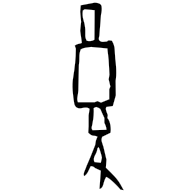 甲骨文 oracle bone · 商
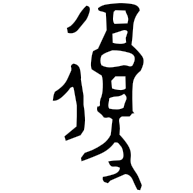 金文 bronze · 西周早期
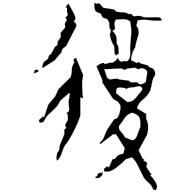 戰國文字 Warring States · 春秋晚期或戰國早期.晉
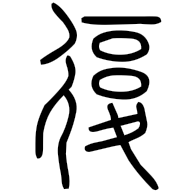 篆文 seal
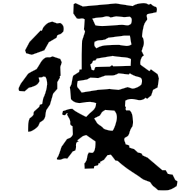 隸書 clerical · 秦
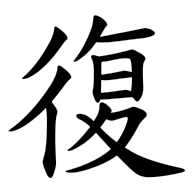 楷書 regular
Legge's note (1882)
Legge's title for the hexagram: returning.
XXIV. Fû symbolises the idea of returning, coming back or over again. The last hexagram showed us inferior prevailing over superior men, all that is good in nature and society yielding before what is bad. But change is the law of nature and society. When decay has reached its climax, recovery will begin to take place. In Po we had one strong topmost line, and five weak lines below it; here we have one strong line, and five weak lines above it. To illustrate the subject from what we see in nature,—Po is the hexagram of the ninth month, in which the triumph of cold and decay in the year is nearly complete. It is complete in the tenth month, whose hexagram is Khwăn; then follows our hexagram Fû, belonging to the eleventh month, in which was the winter solstice when the sun turned back in his course, and moved with a constant regular progress towards the summer solstice. In harmony with these changes of nature are the changes in the political and social state of a nation. There is nothing in the Yî to suggest the hope of a perfect society or kingdom that cannot be moved. The strong bottom line is the first of Kăn, the trigram of movement, and the upper trigram is Khwăn, denoting docility and capacity. The strong returning line will meet with no distressing obstacle, and the weak lines will change before it into strong, and be as friends. The bright quality will be developed brighter and brighter from day to day, and month to month. The sentence, ‘In seven days comes his return,’ occasions some perplexity. If the reader will refer to hexagrams 44, 33, 12, 20, 23, and 2, he will see that during the months denoted by those figures, the 5th, 6th, 7th, 8th, 9th, and 10th, the yin lines have gradually been prevailing over the yang, until in Khwăn (2) they have extruded them entirely from the lineal figure. Then comes our Fû, as a seventh figure, in which the yang line begins to reassert itself, and from which it goes on to extrude the yin lines in their turn. Explained therefore of the months of the year, we have to take a day for a month. And something analogous—we cannot say exactly what—must have place in society and the state. The concluding auspice or oracle to him who finds this Fû by divination is what we might expect. The subject of line 1 is of course the undivided line, meaning here, says Khăng-ȝze, ‘the way of the superior man.’ There must have been some deviation from that, or ‘returning’ could not be spoken of. Line 2 is in its proper place, and central; but it is weak. This is more than compensated for, however, by its adherence to line 1, the fifth line not being a proper correlate. Hence the return of its subject is called excellent or admirable. Line 3 is weak, and in the uneven place of a strong line. It is the top line, moreover, of the trigram whose attribute is movement. Hence the symbolism; but any evil issue may be prevented by a realisation of danger and by caution. Line 4 has its proper correlate in 1; different from all the other weak lines; and its course is different accordingly. Line 5 is in the central place of honour, and the middle line of Khwăn, denoting docility. Hence its auspice. Line 6 is weak; and being at the top of the hexagram, when its action of returning is all concluded, action on the part of its subject will lead to evils such as are mentioned. ‘Ten years’ seems to be a round number, signifying a long time, as in hexagram 3. 2.
Sources
- Chinese text: 周易, 維基文庫, page (revision 10643037); the text is public domain, the site's edits CC BY-SA 4.0.
- English: James Legge, The Yî King, Sacred Books of the East vol. XVI, Oxford 1882 (public domain), where this hexagram is “Fû”.
- Glyph images: 小學堂 字形演變, Academia Sinica (CC0 1.0).
- Pinyin: Unihan (Unicode License v3) with this site's readings for the classical cases. English gloss, relations, the idiom glosses, the English of the chronicle passages and the plain reading: this site.