- The 64
- Hexagram 44
44 姤 Encounter
巽 Wind below, 乾 Heaven above
One weak line arriving under five strong ones: encounter, the unexpected meeting. The text's one sentence is a warning: the woman is strong; do not marry her.
Tap a line of the figure to see where it leads when it changes. Cast for a question of your own. New here? What the I Ching is, coming from tarot.
This site's reading
卦辭 女壯,勿用取女: the woman is strong; do not take her as a wife. The mirror of Resolve: there the last weak line leaves at the top, here the first arrives at the bottom, and the text sees where that leads.
彖 The commentary: 姤 is to meet, the yielding meeting the firm. Not to be married because she cannot be lived with long. Heaven and earth meet and all things show their forms; the firm meets the central and correct and the world goes greatly forward. "Great is the meaning of encounter's time."
大象 Wind under heaven: the ruler issues commands and proclaims them to the four quarters. Wind reaches everywhere; so should the word.
爻 The lines: tied to a metal brake, firm and good, going brings evil, a lean pig that will pace about; a fish in the wallet, no blame, not for guests; buttocks without skin, walking haltingly, danger, no great blame; no fish in the wallet, which starts evil; a willow wrapping the melon, hidden brightness, something falls from heaven; and at the top meeting with the horns, regret, no blame. The first line is the whole hexagram: brake the small thing early.
If your question is about
- A relationship
- The text's plainest no: a strong, early attraction that cannot last (the Judgment). Brake it at the first line; the meeting is not the keeping.
- Work
- An encounter that looks small and grows; tie it to the metal brake (line 1) now. Keep the fish in the wallet (line 2).
- A decision
- Do not commit to what arrived uninvited. Issue your commands clearly (the Image) and wait for what falls from heaven (line 5).
- No line changing
- Encounter as a standing state: the weak line stays below. Keep the brake on; the meeting is not the marriage.
Written from the text above and checked against it by Lun (2026-10-24). It is a way of reading the hexagram, not a prediction.
The text, with Legge
Judgment 卦辭
姤:女壯,勿用取女。
Kâu shows a female who is bold and strong. It will not be good to marry (such) a female. (Legge, 1882)
Commentary on the Judgment 彖
姤,遇也,柔遇剛也。勿用取女,不可與長也。天地相遇,品物咸章也。剛遇中正,天下大行也。姤之時義大矣哉!
The Image 大象
天下有風,姤;后以施命誥四方。
The six lines
Line 1 初六
系于金柅,貞吉,有攸往,見凶,羸豕,孚,蹢躅。
The first line, divided, shows how its subject should be kept (like a carriage) tied and fastened to a metal drag, in which case with firm correctness there will be good fortune. (But) if he move in any direction, evil will appear. He will be (like) a lean pig, which is sure to keep jumping about. (Legge, 1882)
The Image 小象
系于金柅,柔道牽也。
Changing, this line leads to 1 乾 Qián.
Line 2 九二
包有魚,无咎,不利賓。
The second line, undivided, shows its subject with a wallet of fish. There will be no error. But it will not be well to let (the subject of the first line) go forward to the guests. (Legge, 1882)
The Image 小象
包有魚,義不及賓也。
Changing, this line leads to 33 遯 Dùn.
Line 3 九三
臀无膚,其行次且,厲,无大咎。
The third line, undivided, shows one from whose buttocks the skin has been stripped so that he walks with difficulty. The position is perilous, but there will be no great error. (Legge, 1882)
The Image 小象
其行次且,行未牽也。
Changing, this line leads to 6 訟 Sòng.
Line 4 九四
包无魚,起凶。
The fourth line, undivided, shows its subject with his wallet, but no fish in it. This will give rise to evil. (Legge, 1882)
The Image 小象
无魚之凶,遠民也。
Changing, this line leads to 57 巽 Xùn.
Line 5 九五
以杞包瓜,含章,有隕自天。
The fifth line, undivided, (shows its subject as) a medlar tree overspreading the gourd (beneath it). If he keep his brilliant qualities concealed, (a good issue) will descend (as) from Heaven. (Legge, 1882)
The Image 小象
九五含章,中正也。有隕自天,志不舍命也。
Changing, this line leads to 50 鼎 Dǐng.
Line 6 上九
姤其角,吝,无咎。
The sixth line, undivided, shows its subject receiving others on his horns. There will be occasion for regret, but there will be no error. (Legge, 1882)
The Image 小象
姤其角,上窮吝也。
Changing, this line leads to 28 大過 Dà Guò.
In the calendar
In the Han dynasty's 卦氣 tradition, which lays the hexagrams over the year, 姤 is one of the twelve sovereign hexagrams 消息卦: it governs the month that begins at 夏至, summer solstice, and runs until 大暑 (great heat), the fifth month of the traditional year, the month of 午. One yin line enters at the bottom: the turn toward dark begins at midsummer.
The calendar is a later tradition about the hexagrams, not part of the text above.
Related hexagrams
Where the name comes from
姤
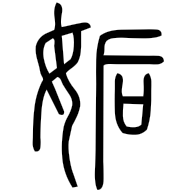 篆文 seal
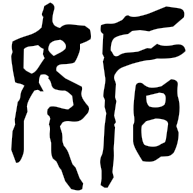 隸書 clerical
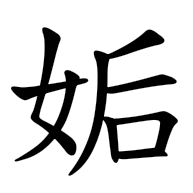 楷書 regular
Legge's note (1882)
Legge's title for the hexagram: .
XLIV. The single, divided, line at the top of Kwâi, the hexagram of the third month, has been displaced, and Khien has ruled over the fourth month of the year. But the innings of the divided line commence again; and here we have in Kâu the hexagram of the fifth month, when light and heat are supposed both to begin to be less. In that divided line Wăn saw the symbol of the small or unworthy man, beginning to insinuate himself into the government of the country. His influence, if unchecked, would go on to grow, and he would displace one good man after another, and fill the vacant seats with others like-minded with himself. The object of Wăn in his Thwan, therefore, was to enjoin resistance to the encroachment of this bad man. Kâu is defined as giving the idea of suddenly and casually encountering or meeting with. So does the divided line appear all at once in the figure. And this significance of the name rules in the interpretation of the lines, so as to set on one side the more common interpretation of them according to the correlation; showing how the meaning of the figures was put into them from the minds of Wăn and Tan in the first place. The sentiments of the Text are not learned from them; but they are forced and twisted, often fantastically, and made to appear to give those sentiments forth of themselves. Here the first line, divided, where it ought to be the contrary, becomes the symbol of a bold, bad woman, who appears unexpectedly on the scene, and wishes to subdue or win all the five strong lines to herself. No one would contract a marriage with such a female; and every good servant of his country will try to repel the entrance into the government of every officer who can be so symbolised. Line 1 represents the bête noire of the figure. If its subject can be kept back, the method of firm government and order will proceed. If he cannot be restrained, he will become disgusting and dangerous. It is not enough for the carriage to be stopt by the metal drag; it is also tied or bound to some steadfast object. Internal and external restraints should be opposed to the bad man. The ‘wallet of fish’ under line 2 is supposed to symbolise the subject of line 1. It has come into the possession of the subject of 2, by virtue of the meaning of the name Kâu, which I have pointed out. With his strength therefore he can repress the advance of 1. He becomes in fact ‘the lord of the hexagram,’ and all the other strong lines are merely guests; and especially is it important that he should prevent 1 from approaching them. This is a common explanation of what is said under this second line. It seems far-fetched; but I can neither find nor devise anything better. With what is said on line 3, compare the fourth paragraph of the duke’s Text on the preceding hexagram. Line 3 is strong, but has gone beyond the central place; has no correlate above; and is cut off from 1 by the intervening 2. It cannot do much therefore against 1; but its aim being to repress that, there will be no great error. Line 1 is the proper correlate of 4; but it has already met and associated with 2. The subject of 4 therefore stands alone; and evil to him may be looked for. Line 5 is strong, and in the ruler’s place. Its relation to 1 is like that of a forest tree to the spreading gourd. But let not its subject use force to destroy or repress the growth of 1; but let him restrain himself and keep his excellence concealed, and Heaven will set its seal to his virtue. The symbolism of line 6 is difficult to understand, though the meaning of what is said is pretty clear. The Khang-hsî editors observe:—‘The subject of this line is like an officer who has withdrawn from the world. He can accomplish no service for the time; but his person is removed from the workers of disorder.’
Sources
- Chinese text: 周易, 維基文庫, page (revision 10646826); the text is public domain, the site's edits CC BY-SA 4.0.
- English: James Legge, The Yî King, Sacred Books of the East vol. XVI, Oxford 1882 (public domain), where this hexagram is “Kâu”.
- Glyph images: 小學堂 字形演變, Academia Sinica (CC0 1.0).
- Pinyin: Unihan (Unicode License v3) with this site's readings for the classical cases. English gloss, relations, the idiom glosses, the English of the chronicle passages and the plain reading: this site.