- The 64
- Hexagram 2
2 坤 Earth
坤 Earth below, 坤 Earth above
Six divided lines: the receptive, the ground that carries everything. The text says this works too, by following rather than leading, and that a mare's steadiness is its measure.
Tap a line of the figure to see where it leads when it changes. Cast for a question of your own. New here? What the I Ching is, coming from tarot.
This site's reading
卦辭 The Judgment gives Earth the same marks as Heaven, 元亨, then adds the mare: 利牝馬之貞, the firmness of a mare, strong and yet led. The noble person who moves first goes astray and who follows finds a master; friends are gained in the south-west and lost in the north-east; rest in firmness and it is good. The counsel is to take the second place well.
彖 The commentary matches Heaven's "all things take their start" with Earth's "all things take their birth" (萬物資生): the one begins, the other brings forth, by receiving the sky. Earth is thick and carries things; the mare belongs to it and walks it without limit.
大象 The Image: the earth lies as it lies (地勢坤), and the noble person, with generous virtue, carries things (厚德載物). Heaven's line is effort; this one is capacity.
爻 The lines: frost underfoot, and hard ice coming; straight, square and great, right without rehearsal; excellence kept under restraint, finishing another's work without claiming it; a sack tied shut, neither blame nor praise; the yellow lower garment, greatly good; and at the top dragons fighting in the wild, their blood dark and yellow, the one place where yielding has pushed too far. All six changing: lasting firmness is the advantage.
If your question is about
- A relationship
- Receive and carry rather than lead; the one who follows finds the right partner. Watch the top line: yielding that curdles into a fight.
- Work
- Second place, done fully: finish the work without claiming it (line 3). Reward comes as the yellow garment, quietly.
- A decision
- Do not move first. Follow what is already in motion and rest in firmness; the south-west, your own kind, is where friends are.
- No line changing
- Pure yin at rest: capacity without initiative. Patience and steadiness are all that is asked; the frost says what is coming, not what to do.
Written from the text above and checked against it by Lun (2026-10-24). It is a way of reading the hexagram, not a prediction.
The text, with Legge
Judgment 卦辭
坤:元亨。利牝馬之貞。君子有攸往,先迷後得主。利西南得朋,東北喪朋。安貞,吉。
Khwăn (represents) what is great and originating, penetrating, advantageous, correct and having the firmness of a mare. When the superior man (here intended) has to make any movement, if he take the initiative, he will go astray; if he follow, he will find his (proper) lord. The advantageousness will be seen in his getting friends in the south-west, and losing friends in the north-east. If he rest in correctness and firmness, there will be good fortune. (Legge, 1882)
Commentary on the Judgment 彖
至哉坤元,萬物資生,乃順承天。坤厚載物,德合无疆;含弘光大,品物咸亨。牝馬地類,行地无疆,柔順利貞。君子攸行,先迷失道,後順得常。西南得朋,乃與類行,東北喪朋,乃終有慶。安貞之吉,應地无疆。
The Image 大象
地勢坤,君子以厚德載物。
Words of the Text 文言
坤至柔而動也剛,至靜而德方。後得主而有常,含萬物而化光。坤道其順乎!承天而時行。 積善之家,必有餘慶;積不善之家,必有餘殃。臣弒其君,子弒其父,非一朝一夕之故,其所由來者漸矣。由辨之不早辨也。易曰:「履霜,堅冰至。」蓋言順也。 直其正也,方其義也。君子敬以直內,義以方外,敬義立而德不孤。「直方大,不習无不利。」則不疑其所行也。 陰雖有美,含之。以從王事,弗敢成也。地道也,妻道也,臣道也。地道无成,而代有終也。 天地變化,草木蕃;天地閉,賢人隱。易曰:「括囊,无咎,无譽。」蓋言謹也。 君子黃中通理,正位居體,美在其中,而暢於四支,發於事業,美之至也。 陰疑於陽必戰,為其嫌於无陽也,故稱龍焉。猶未離其類也,故稱血焉。夫玄黃者,天地之雜也。天玄而地黃。
The six lines
Line 1 初六
履霜,堅冰至。
In the first line, divided, (we see its subject) treading on hoarfrost. The strong ice will come (by and by). (Legge, 1882)
The Image 小象
履霜堅冰,陰始凝也。馴致其道,至堅冰也。
Changing, this line leads to 24 復 Fù.
Line 2 六二
直方大,不習无不利。
The second line, divided, (shows the attribute of) being straight, square, and great. (Its operation), without repeated efforts, will be in every respect advantageous. (Legge, 1882)
The Image 小象
六二之動,直以方也。不習无不利,地道光也。
Changing, this line leads to 7 師 Shī.
Line 3 六三
含章,可貞。或從王事,无成有終。
The third line, divided, (shows its subject) keeping his excellence under restraint, but firmly maintaining it. If he should have occasion to engage in the king’s service, though he will not claim the success (for himself), he will bring affairs to a good issue. (Legge, 1882)
The Image 小象
含章可貞,以時發也。或從王事,知光大也。
Changing, this line leads to 15 謙 Qiān.
Line 4 六四
括囊,无咎无譽。
The fourth line, divided, (shows the symbol of) a sack tied up. There will be no ground for blame or for praise. (Legge, 1882)
The Image 小象
括囊无咎,慎不害也。
Changing, this line leads to 16 豫 Yù.
Line 5 六五
黃裳,元吉。
The fifth line, divided, (shows) the yellow lower garment. There will be great good fortune. (Legge, 1882)
The Image 小象
黃裳元吉,文在中也。
Changing, this line leads to 8 比 Bǐ.
Line 6 上六
龍戰于野,其血玄黃。
The sixth line, divided, (shows) dragons fighting in the wild. Their blood is purple and yellow. (Legge, 1882)
The Image 小象
龍戰于野,其道窮也。
Changing, this line leads to 23 剝 Bō.
All lines 用六
利永貞。
(The lines of this hexagram are all weak and divided as appears from) the use of the number six. If those (who are thus represented) be perpetually correct and firm, advantage will arise. (Legge, 1882)
The Image 小象
用六永貞,以大終也。
Words that came from it
Phrases a billion people use today began as clauses of this hexagram.
- 厚德載物
- a deep character carries all things, as the earth does. The second half of that pair; the two together are the most quoted eight characters of the book. From the Image 大象: 厚德載物.
- 履霜堅冰
- treading on frost, hard ice is coming. Small signs announce large consequences; quoted about early warnings of every kind. From line 1: 履霜,堅冰至.
In history
The 左傳 and 國語, the chronicles of the sixth to fifth centuries BC, record real casts of the Changes and what came of them. One of them gave this hexagram.
530 BC: 南蒯, steward of the 季 family in 費, planning revolt
Asked: Will my plan succeed? The stalks gave 2 坤 with line 5 changing, to 8 比.
吾嘗學此矣.忠信之事則可.不然必敗.外彊内溫.忠也.和以率貞.信也.故曰黃裳元吉.南蒯 cast without stating his question and took the fifth line of 坤, 'yellow skirt, great fortune', as the best of signs. 子服惠伯 told him the line holds only for a loyal and honest undertaking: yellow is the centre's colour, the skirt the lower garment, and a disloyal man gets neither. The Changes cannot divine a crooked venture.
南蒯 took 費 into revolt against the 季 family. In 528 BC the people of 費 turned on him and he fled to 齊, where the duke called him a traitor to his face.
左傳 昭公十二年, 維基文庫 (revision 10445713). The line text 黃裳元吉 matches the received 坤 六五. The page writes 内 for 內.
The chronicles' diviners read from oracle texts of their own time; where their words match our clause text the note says so, and where they do not, it says that. None of this is a claim that the text foretold the event.
In the calendar
In the Han dynasty's 卦氣 tradition, which lays the hexagrams over the year, 坤 is one of the twelve sovereign hexagrams 消息卦: it governs the month that begins at 小雪, light snow, and runs until 冬至 (winter solstice), the tenth month of the traditional year, the month of 亥. All six lines yin; the dark is complete and the return is next.
The calendar is a later tradition about the hexagrams, not part of the text above.
Related hexagrams
Where the name comes from
坤
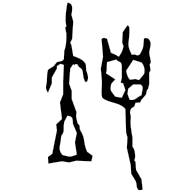 戰國文字 Warring States · 戰國
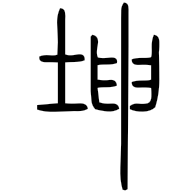 篆文 seal
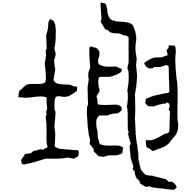 隸書 clerical · 東漢
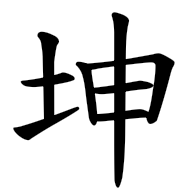 楷書 regular
Legge's note (1882)
Legge's title for the hexagram: .
II. The same attributes are here ascribed to Khwăn, as in the former hexagram to Khien;—but with a difference. The figure, made up of six divided lines, expresses the ideal of subordination and docility. The superior man, represented by it, must not take the initiative; and by following he will find his lord,—the subject, that is of Khien. Again, the correctness and firmness is defined to be that of ‘a mare,’ ‘docile and strong,’ but a creature for the service of man. That it is not the sex of the animal which the writer has chiefly in mind is plain from the immediate mention of the superior man, and his lord. That superior man will seek to bring his friends along with himself to serve his ruler. But according to the arrangement of the trigrams by king Wăn, the place of Khwăn is in the south-west, while the opposite quarter is occupied by the yang trigram Kăn, as in Figure 2, Plate III. All that this portion of the Thwan says is an instruction to the subject, of the hexagram to seek for others of the same principles and tendencies with himself to serve their common lord. But in quietness and firmness will be his strength. The symbolism of the lines is various. Paragraph 2 presents to us the earth itself, according to the Chinese conception of it, as a great cube. To keep his excellence under restraint, as in paragraph 3, is the part of a minister or officer, seeking not his own glory, but that of his ruler. Paragraph 4 shows its subject exercising a still greater restraint on himself than in paragraph 3. There is an interpretation of the symbolism of paragraph 5 in a narrative of the Ȝo-Kwan, under the 12th year of duke Khâo, B.C. 530. ‘Yellow’ is one of the five ‘correct’ colours, and the colour of the earth. ‘The lower garment’ is a symbol of humility. The fifth line is the seat of honour. If its occupant possess the qualities indicated, he will be greatly fortunate. See the note on the sixth line of hexagram 1. What is there said to be ‘beyond the proper limits’ takes place here ‘in the wild.’ The humble subject of the divided line is transformed into a dragon, and fights with the true dragon, the subject of the undivided line. They fight and bleed, and their blood is of the colour proper to heaven or the sky, and the colour proper to the earth. Paragraph 7 supposes that the hexagram Khwăn should become changed into Khien;—the result of which would be good.
Sources
- Chinese text: 周易, 維基文庫, page (revision 2404999); the text is public domain, the site's edits CC BY-SA 4.0.
- English: James Legge, The Yî King, Sacred Books of the East vol. XVI, Oxford 1882 (public domain), where this hexagram is “Khwăn”.
- Glyph images: 小學堂 字形演變, Academia Sinica (CC0 1.0).
- Pinyin: Unihan (Unicode License v3) with this site's readings for the classical cases. English gloss, relations, the idiom glosses, the English of the chronicle passages and the plain reading: this site.