- The 64
- Hexagram 37
37 家人 The Household
離 Fire below, 巽 Wind above
Wind coming out of fire: the household, order that begins at the hearth. The text says what is advantageous is the woman's firmness; the commentary sets the whole world's order on the family's.
Tap a line of the figure to see where it leads when it changes. Cast for a question of your own. New here? What the I Ching is, coming from tarot.
This site's reading
卦辭 利女貞: advantageous for the woman to be firm. The house, in the old text, stands or falls on the one who keeps its inside.
彖 The commentary: the woman's correct place is within, the man's without; man and woman correct is heaven and earth's great meaning. The household has stern rulers, the parents. Father as father, son as son, elder as elder, younger as younger, husband as husband, wife as wife: the family's way is correct, and with correct families the world is settled.
大象 Wind from fire: the noble person's words have substance and his conduct has constancy. A house is kept by what is said and done in it every day.
爻 The lines: a fenced household, regret gone; nothing pursued, staying in the centre with the food, firm and good; the household stern, regret and danger but good, the wife and children giggling, mean in the end; enriching the family, greatly good; the king reaching his household, no anxiety, good; and at the top sincerity and dignity, good in the end. Severity is faulted less than laxity (line 3); sincerity with dignity closes it.
If your question is about
- A relationship
- Each in their proper place, the inside kept well (lines 2 and 4). Sternness has regret but ends well; giggling laxity ends mean.
- Work
- The household's rules apply: words with substance, conduct with constancy (the Image). Order in the small unit first.
- A decision
- Decide as a household, with each role clear; the king reaches his family (line 5) before the state.
- No line changing
- The household as a steady state: fences up (line 1), roles kept, dignity at the top. Nothing here moves outward; it holds.
Written from the text above and checked against it by Lun (2026-10-24). It is a way of reading the hexagram, not a prediction.
The text, with Legge
Judgment 卦辭
家人:利女貞。
For (the realisation of what is taught in) Kiâ Zăn, (or for the regulation of the family), what is most advantageous is that the wife be firm and correct. (Legge, 1882)
Commentary on the Judgment 彖
家人,女正位乎內,男正位乎外,男女正,天地之大義也。家人有嚴君焉,父母之謂也。父父,子子,兄兄,弟弟,夫夫,婦婦,而家道正;正家而天下定矣。
The Image 大象
風自火出,家人;君子以言有物,而行有恆。
The six lines
Line 1 初九
閑有家,悔亡。
The first line, undivided, shows its subject establishing restrictive regulations in his household. Occasion for repentance will disappear. (Legge, 1882)
The Image 小象
閑有家,志未變也。
Changing, this line leads to 53 漸 Jiàn.
Line 2 六二
无攸遂,在中饋,貞吉。
The second line, divided, shows its subject taking nothing on herself, but in her central place attending to the preparation of the food. Through her firm correctness there will be good fortune. (Legge, 1882)
The Image 小象
六二之吉,順以巽也。
Changing, this line leads to 9 小畜 Xiǎo Chù.
Line 3 九三
家人嗃嗃,悔厲吉;婦子嘻嘻,終吝。
The third line, undivided, shows its subject (treating) the members of the household with stern severity. There will be occasion for repentance, there will be peril, (but) there will (also) be good fortune. If the wife and children were to be smirking and chattering, in the end there would be occasion for regret. (Legge, 1882)
The Image 小象
家人嗃嗃,未失也;婦子嘻嘻,失家節也。
Changing, this line leads to 42 益 Yì.
Line 4 六四
富家,大吉。
The fourth line, divided, shows its subject enriching the family. There will be great good fortune. (Legge, 1882)
The Image 小象
富家大吉,順在位也。
Changing, this line leads to 13 同人 Tóng Rén.
Line 5 九五
王假有家,勿恤。吉。
The fifth line, undivided, shows the influence of the king extending to his family. There need be no anxiety; there will be good fortune. (Legge, 1882)
The Image 小象
王假有家,交相愛也。
Changing, this line leads to 22 賁 Bì.
Line 6 上九
有孚威如,終吉。
The topmost line, undivided, shows its subject possessed of sincerity and arrayed in majesty. In the end there will be good fortune. (Legge, 1882)
The Image 小象
威如之吉,反身之謂也。
Changing, this line leads to 63 既濟 Jì Jì.
Related hexagrams
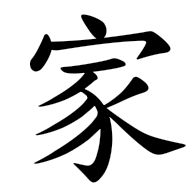
Where the name comes from
家
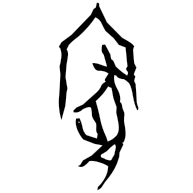 甲骨文 oracle bone · 商
 金文 bronze · 商代晚期
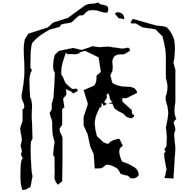 戰國文字 Warring States · 戰國.晉
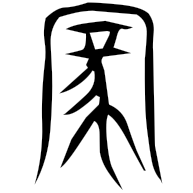 篆文 seal
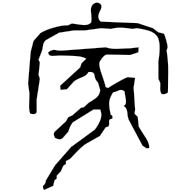 隸書 clerical · 秦
 楷書 regular
人
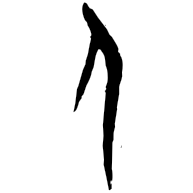 甲骨文 oracle bone · 商
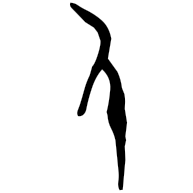 金文 bronze · 西周早期
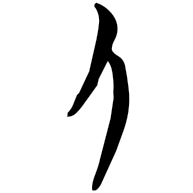 戰國文字 Warring States · 戰國.楚
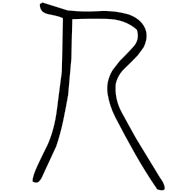 篆文 seal
 隸書 clerical · 秦
 楷書 regular
Legge's note (1882)
Legge's title for the hexagram: a household, the members of a family.
XXXVII. Kiâ Zăn, the name of the hexagram, simply means ‘a household,’ or ‘the members of a family.’ The subject of the essay based on the figure, however, is the regulation of the family, effected mainly by the co-operation of husband and wife in their several spheres, and only needing to become universal to secure the good order of the kingdom. The important place occupied by the wife in the family is seen in the short sentence of the Thwan. That she be firm and correct, and do her part well, is the first thing necessary to its regulation. Line 1 is strong, and in a strong place. It suggests the necessity of strict rule in governing the family. Regulations must be established, and their observance strictly insisted on. Line 2 is weak, and in the proper place for it,—the centre, moreover, of the lower trigram. It fitly represents the wife, and what is said on it tells us of her special sphere and duty; and that she should be unassuming in regard to all beyond her sphere; always being firm and correct. See the Shih, III, 350. Line 3 is strong, and in an odd place. If the place were central, the strength would be tempered; but the subject of the line, in the topmost place of the trigram, may be expected to exceed in severity. But severity is not a bad thing in regulating a family;—it is better than laxity and indulgence. Line 4 is weak, and in its proper place. The wife is again suggested to us, and we are told, that notwithstanding her being confined to the internal affairs of the household, she can do much to enrich the family. The subject of the strong fifth line appears as the king. This may be the husband spoken of as also a king; or the real king whose merit is revealed first in his family, as often in the Shih, where king Wăn is the theme. The central place here tempers the display of the strength and power. Line 6 is also strong, and being in an even place, the subject of it might degenerate into stern severity, but he is supposed to be sincere, complete in his personal character and self-culture, and hence his action will only lead to good fortune.
Sources
- Chinese text: 周易, 維基文庫, page (revision 2405005); the text is public domain, the site's edits CC BY-SA 4.0.
- English: James Legge, The Yî King, Sacred Books of the East vol. XVI, Oxford 1882 (public domain), where this hexagram is “Kiâ Zăn”.
- Glyph images: 小學堂 字形演變, Academia Sinica (CC0 1.0).
- Pinyin: Unihan (Unicode License v3) with this site's readings for the classical cases. English gloss, relations, the idiom glosses, the English of the chronicle passages and the plain reading: this site.