- The 64
- Hexagram 13
13 同人 Fellowship
離 Fire below, 乾 Heaven above
Fire under heaven, rising to meet it: fellowship, people in the open country. The text says it gets through, that the great stream can be crossed, and that the noble person's firmness is the condition.
Tap a line of the figure to see where it leads when it changes. Cast for a question of your own. New here? What the I Ching is, coming from tarot.
This site's reading
卦辭 Fellowship in the open (于野), it gets through; advantageous to cross the great stream; advantageous for the noble person to be firm. The open field matters: fellowship that is wide, not a clique.
彖 The commentary: the yielding line has its place and the centre and responds to Heaven; that is fellowship. Crossing the stream is Heaven's action; cultured and strong, central, correct and responsive, the noble person's correctness. Only the noble person can join the wills of the world (通天下之志).
大象 Heaven with fire: the noble person sorts the kinds and distinguishes things (類族辨物). Fellowship is not sameness; it knows who is who.
爻 The lines: fellowship at the gate, no blame; fellowship within the clan, regret; arms hidden in the grass, climbing the high hill, nothing for three years; mounted on the wall and unable to attack, good; fellowship that first wails and then laughs, the great armies meet; and at the top fellowship in the outskirts, no regret. The narrowing is the warning (the clan, the ambush); the opening is the counsel (the gate, the field).
If your question is about
- A relationship
- Fellowship in the open, not a closed pair against the world (line 2's clan brings regret). Line 5: tears first, then laughter.
- Work
- Wide alliances cross the stream; cliques regret. Sort the kinds (the Image) and know who belongs to what.
- A decision
- Go out by the gate (line 1); do not lie in ambush (line 3). It works when done in the open with the right people.
- No line changing
- Fellowship as a state: open, cultured, strong. Keep it in the field; the clan is where it sours.
Written from the text above and checked against it by Lun (2026-10-24). It is a way of reading the hexagram, not a prediction.
The text, with Legge
Judgment 卦辭
同人于野,亨。 利涉大川,利君子貞。
Thung Zăn (or ‘Union of men’) appears here (as we find it) in the (remote districts of the) country, indicating progress and success. It will be advantageous to cross the great stream. It will be advantageous to maintain the firm correctness of the superior man. (Legge, 1882)
Commentary on the Judgment 彖
同人,柔得位得中,而應乎乾,曰同人。同人曰,同人于野,亨。利涉大川,乾行也。文明以健,中正而應,君子正也。唯君子為能通天下之志。
The Image 大象
天與火,同人;君子以類族辨物。
The six lines
Line 1 初九
同人于門,無咎。
The first line, undivided, (shows the representative of) the union of men just issuing from his gate. There will be no error. (Legge, 1882)
The Image 小象
出門同人,又誰咎也。
Changing, this line leads to 33 遯 Dùn.
Line 2 六二
同人于宗,吝。
The second line, divided, (shows the representative of) the union of men in relation with his kindred. There will be occasion for regret. (Legge, 1882)
The Image 小象
同人于宗,吝道也。
Changing, this line leads to 1 乾 Qián.
Line 3 九三
伏戎于莽,升其高陵,三歲不興。
The third line, undivided, (shows its subject) with his arms hidden in the thick grass, and at the top of a high mound. (But) for three years he makes no demonstration. (Legge, 1882)
The Image 小象
伏戎于莽,敵剛也。三歲不興,安行也。
Changing, this line leads to 25 无妄 Wú Wàng.
Line 4 九四
乘其庸,弗克攻,吉。
The fourth line, undivided, (shows its subject) mounted on the city wall; but he does not proceed to make the attack (he contemplates). There will be good fortune. (Legge, 1882)
The Image 小象
乘其庸,義弗克也,其吉,則困而反則也。
Changing, this line leads to 37 家人 Jiā Rén.
Line 5 九五
同人,先號啕而後笑。大師克相遇。
In the fifth line, undivided, (the representative of) the union of men first wails and cries out, and then laughs. His great host conquers, and he (and the subject of the second line) meet together. (Legge, 1882)
The Image 小象
同人之先,以中直也。大師相遇,言相克也。
Changing, this line leads to 30 離 Lí.
Line 6 上九
同人于郊,無悔。
The topmost line, undivided, (shows the representative of) the union of men in the suburbs. There will be no occasion for repentance. (Legge, 1882)
The Image 小象
同人于郊,志未得也。
Changing, this line leads to 49 革 Gé.
Related hexagrams
Where the name comes from
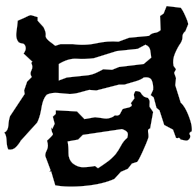
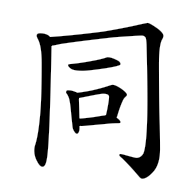
同
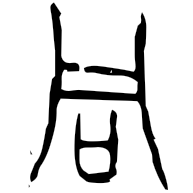 甲骨文 oracle bone · 商
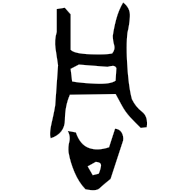 金文 bronze · 西周早期
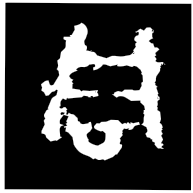 戰國文字 Warring States · 戰國.齊
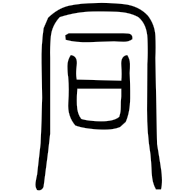 篆文 seal
 隸書 clerical · 秦
 楷書 regular
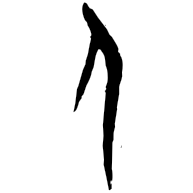
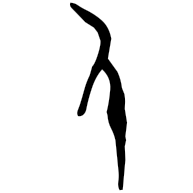
人
 甲骨文 oracle bone · 商
 金文 bronze · 西周早期
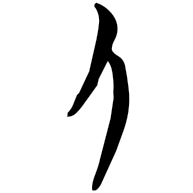 戰國文字 Warring States · 戰國.楚
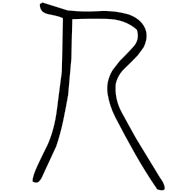 篆文 seal
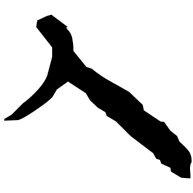 隸書 clerical · 秦
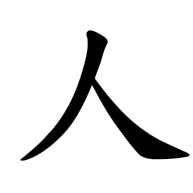 楷書 regular
Legge's note (1882)
Legge's title for the hexagram: Union of men.
XIII. Thung Zăn describes a condition of nature and of the state opposite to that of Phî. There was distress and obstruction; here is union. But the union must be based entirely on public considerations, without taint of selfishness. The strong line in the fifth, its correct, place, occupies the most important position, and has for its correlate the weak second line, also in its correct place. The one divided line is naturally sought after by all the strong lines. The upper trigram is that of heaven, which is above; the lower is that of fire, whose tendency is to mount upwards. All these things are in harmony with the idea of union. But the union must be free from all selfish motives, and this is indicated by its being in the remote districts of the country, where people are unsophisticated, and free from the depraving effects incident to large societies. A union from such motives will cope with the greatest difficulties; and yet a word of caution is added. Line 1 emblems the first attempts at union. It is strong, but in the lowest place; and it has no proper correlate above. There is, however, no intermixture of selfishness in it. Lines 2 and 5 are proper correlates, which fact suggests in this hexagram the idea of their union being limited and partial, and such as may afford ground for blame. Line 3 is strong, and in an odd place; but it has not a proper correlate in 6. This makes its subject more anxious to unite with 2; but 2 is devoted to its proper correlate in 5, of whose strength 3 is afraid, and takes the measures described. His abstaining so long, however, from any active attempt, will save him from misfortune. Line 4 is strong, but in an even place, which weakens its subject. He also would fain make an attempt on 2; but he is afraid, and does not carry his purpose into effect. Line 5 is strong, in an odd, and the central place; and would fain unite with 2, which indeed is the proper correlate of its subject. But 3 and 4 are powerful foes that oppose the union. Their opposition makes him weep; but he collects his forces, defeats them, and effects his purpose. The union reaches to all within the suburbs, and is not yet universal; but still there is no cause for repentance.
Sources
- Chinese text: 周易, 維基文庫, page (revision 10645635); the text is public domain, the site's edits CC BY-SA 4.0.
- English: James Legge, The Yî King, Sacred Books of the East vol. XVI, Oxford 1882 (public domain), where this hexagram is “Thung Zăn”.
- Glyph images: 小學堂 字形演變, Academia Sinica (CC0 1.0).
- Pinyin: Unihan (Unicode License v3) with this site's readings for the classical cases. English gloss, relations, the idiom glosses, the English of the chronicle passages and the plain reading: this site.