- The 64
- Hexagram 22
22 賁 Adornment
離 Fire below, 艮 Mountain above
Fire lighting the foot of a mountain: adornment, the grace of form. The text says it gets through, with small advantage in going anywhere; the lines strip the ornament back to white.
Tap a line of the figure to see where it leads when it changes. Cast for a question of your own. New here? What the I Ching is, coming from tarot.
This site's reading
卦辭 亨。小利有攸往: it gets through; small advantage in having somewhere to go. Adornment is for staying and finishing, not for setting out.
彖 The commentary: the yielding comes and patterns the firm, so it gets through; a firm line goes up and patterns the yielding, so small advantage in going. Firm and yielding interlaced is heaven's pattern; culture that knows where to stop is human pattern (人文). View the one to read the seasons, the other to transform the world.
大象 Fire below the mountain: the noble person makes the common business clear and does not dare to decide lawsuits by it. Ornament lights the small things; it is not for judgment.
爻 The lines: adorning the feet, leaving the carriage and walking; adorning the beard; adorned and glistening, lasting firmness is good; adorned, then plain white, a white horse flying, no bandit but a suitor; adornment of the hill garden, a bundle of silk, small and meagre, regret and then good; and at the top white adornment, no blame. The ornament thins as the lines rise, until the top is plain.
If your question is about
- A relationship
- Grace of form, and the question of what is under it; the white-horse suitor (line 4) is honest. Keep firmness under the glisten.
- Work
- Polish and presentation, with small ventures only; do not decide the big cases on looks (the Image). Plain white at the end is best.
- A decision
- A small step, done gracefully; not a crossing. Know where culture stops (文明以止).
- No line changing
- Adornment that holds: the fire keeps lighting the mountain's foot. Enjoy the form and keep stripping it back toward white.
Written from the text above and checked against it by Lun (2026-10-24). It is a way of reading the hexagram, not a prediction.
The text, with Legge
Judgment 卦辭
賁:亨。小利有攸往。
Pî indicates that there should be free course (in what it denotes). There will be little advantage (however) if it be allowed to advance (and take the lead). (Legge, 1882)
Commentary on the Judgment 彖
賁,亨;柔來而文剛,故亨。分剛上而文柔,故小利有攸往。剛柔交錯,天文也;文明以止,人文也。觀乎天文,以察時變;觀乎人文,以化成天下。
The Image 大象
山下有火,賁;君子以明庶政,无敢折獄。
The six lines
Line 1 初九
賁其趾,舍車而徒。
The first line, undivided, shows one adorning (the way of) his feet. He can discard a carriage and walk on foot. (Legge, 1882)
The Image 小象
舍車而徒,義弗乘也。
Changing, this line leads to 52 艮 Gèn.
Line 2 六二
賁其須。
The second line, divided, shows one adorning his beard. (Legge, 1882)
The Image 小象
賁其須,與上興也。
Changing, this line leads to 26 大畜 Dà Chù.
Line 3 九三
賁如濡如,永貞吉。
The third line, undivided, shows its subject with the appearance of being adorned and bedewed (with rich favours). But let him ever maintain his firm correctness, and there will be good fortune. (Legge, 1882)
The Image 小象
永貞之吉,終莫之陵也。
Changing, this line leads to 27 頤 Yí.
Line 4 六四
賁如皤如,白馬翰如,匪寇婚媾。
The fourth line, divided, shows one looking as if adorned, but only in white. As if (mounted on) a white horse, and furnished with wings, (he seeks union with the subject of the first line), while (the intervening third pursues), not as a robber, but intent on a matrimonial alliance. (Legge, 1882)
The Image 小象
六四,當位疑也。匪寇婚媾,終无尤也。
Changing, this line leads to 30 離 Lí.
Line 5 六五
賁於丘園,束帛戔戔,吝,終吉。
The fifth line, divided, shows its subject adorned by (the occupants of) the heights and gardens. He bears his roll of silk, small and slight. He may appear stingy; but there will be good fortune in the end. (Legge, 1882)
The Image 小象
六五之吉,有喜也。
Changing, this line leads to 37 家人 Jiā Rén.
Line 6 上九
白賁,无咎。
The sixth line, undivided, shows one with white as his (only) ornament. There will be no error. (Legge, 1882)
The Image 小象
白賁无咎,上得志也。
Changing, this line leads to 36 明夷 Míng Yí.
Words that came from it
Phrases a billion people use today began as clauses of this hexagram.
- 文明
- pattern and brightness. The modern word for civilisation; the commentary on 賁 pairs it with 人文, the pattern of human culture. From the commentary on the Judgment 彖: 文明以止.
Related hexagrams
Where the name comes from
賁
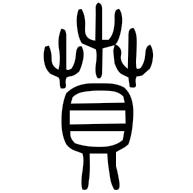 篆文 seal
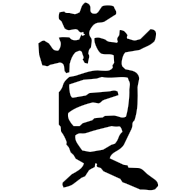 隸書 clerical · 西漢
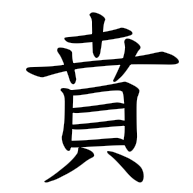 楷書 regular
Legge's note (1882)
Legge's title for the hexagram: ornament, adorning.
XXII. The character Pî is the symbol of what is ornamental and of the act of adorning. As there is ornament in nature, so should there be in society; but its place is secondary to that of what is substantial. This is the view of king Wăn in his Thwan. The symbolism of the separate lines is sometimes fantastic. Line 1 is strong, and in an odd place. It is at the very bottom of the hexagram, and is the first line of Lî, the trigram for fire or light, and suggesting what is elegant and bright. Its subject has nothing to do but to attend to himself. Thus he cultivates—adorns—himself in his humble position; but if need be, righteousness requiring it, he can give up every luxury and indulgence. Line 2 is weak and in its proper place, but with no proper correlate above. The strong line 3 is similarly situated. These two lines therefore keep together, and are as the beard and the chin. Line 1 follows 2. What is substantial commands and rules what is merely ornamental. Line 3 is strong, and between two weak lines, which adorn it, and bestow their favours on it. But this happy condition is from the accident of place. The subject of the line must be always correct and firm to ensure its continuance. Line 4 has its proper correlate in 1, from whose strength it should receive ornament, but 2 and the strong 3 intervene and keep them apart, so that the ornament is only white, and of no bright colour. Line 4, however, is faithful to 1, and earnest for their union. And finally line 3 appears in a good character, and not with the purpose to injure, so that the union of 1 and 4 takes place. All this is intended to indicate how ornament recognises the superiority of solidity. Compare the symbolism of the second line of Kun (3), and that of the topmost line of Khwei (38). Line 5 is in the place of honour, and has no proper correlate in 2. It therefore associates with the strong 6, which is symbolised by the heights and gardens round a city, and serving both to protect and to beautify it. Thus the subject of the line receives adorning from without, and does not of itself try to manifest it. Moreover, in his weakness, his offerings of ceremony are poor and mean. But, as Confucius said, ‘In ceremonies it is better to be sparing than extravagant.’ Hence that stinginess does not prevent a good auspice. Line 6 is at the top of the hexagram. Ornament has had its course, and here there is a return to pure, ‘white,’ simplicity. Substantiality is better than ornament.
Sources
- Chinese text: 周易, 維基文庫, page (revision 2405035); the text is public domain, the site's edits CC BY-SA 4.0.
- English: James Legge, The Yî King, Sacred Books of the East vol. XVI, Oxford 1882 (public domain), where this hexagram is “Pî”.
- Glyph images: 小學堂 字形演變, Academia Sinica (CC0 1.0).
- Pinyin: Unihan (Unicode License v3) with this site's readings for the classical cases. English gloss, relations, the idiom glosses, the English of the chronicle passages and the plain reading: this site.