- The 64
- Hexagram 4
4 蒙 Unknowing
坎 Water below, 艮 Mountain above
A spring at the foot of a mountain: water that has not yet found its course. The text is about teaching and being taught, and it sets the terms: the learner comes to the teacher, and asking three times is not asking.
Tap a line of the figure to see where it leads when it changes. Cast for a question of your own. New here? What the I Ching is, coming from tarot.
This site's reading
卦辭 The Judgment gets through. "I do not seek the young unknowing; the young unknowing seeks me." At the first divination I answer; a second and a third are an affront (瀆), and an affront is not answered. Firmness is advantageous. It is the student's manners and the oracle's at once: ask sincerely, once.
彖 The commentary: danger under the mountain, and stopping before it, is unknowing; it gets through by acting at the right time, from the middle. Wills answer each other (志應), teacher and learner. Nourishing correctness in the unknowing is the work of a sage (聖功).
大象 A spring issuing below the mountain: the noble person acts with resolution (果行) and nurtures virtue. Water finds its way by going, not by waiting.
爻 The lines: unknowing dispelled, with punishment used to loosen the fetters, though to go on so is mean; the unknowing tolerated, which is good, and taking a wife, a son who can run the household; a woman not to be taken, who sees a man of money and loses herself; unknowing hemmed in, regret; the child's unknowing, good; and at the top striking the unknowing, useful against bandits, not for banditry. The fifth line is the heart of it: innocence that admits it does not know.
If your question is about
- A relationship
- Patience with what the other does not yet know is the good line (九二); hemmed-in ignorance and chasing money are the bad ones.
- Work
- Be the one who asks once and listens, or the one who answers once and does not repeat. Nurture before you correct.
- A decision
- You do not know enough yet, and the text is fine with that: the child's unknowing is good. Ask the right person once.
- No line changing
- A state of not knowing that holds. Act with resolution on what you can see, and let the rest be taught.
Written from the text above and checked against it by Lun (2026-10-24). It is a way of reading the hexagram, not a prediction.
The text, with Legge
Judgment 卦辭
蒙:亨。匪我求童蒙,童蒙求我。初筮告,再三瀆,瀆則不告。利貞。
Măng (indicates that in the case which it presupposes) there will be progress and success. I do not (go and) seek the youthful and inexperienced, but he comes and seeks me. When he shows (the sincerity that marks) the first recourse to divination, I instruct him. If he apply a second and third time, that is troublesome; and I do not instruct the troublesome. There will be advantage in being firm and correct. (Legge, 1882)
Commentary on the Judgment 彖
蒙,山下有險,險而止,蒙。蒙亨,以亨行,時中也。匪我求童蒙,童蒙求我,志應也。初筮告,以剛中也。再三瀆,瀆則不告,瀆蒙也。蒙以養正,聖功也。
The Image 大象
山下出泉,蒙;君子以果行育德。
The six lines
Line 1 初六
發蒙,利用刑人,用說桎梏,以往吝。
The first line, divided, (has respect to) the dispelling of ignorance. It will be advantageous to use punishment (for that purpose), and to remove the shackles (from the mind). But going on in that way (of punishment) will give occasion for regret. (Legge, 1882)
The Image 小象
利用刑人,以正法也。
Changing, this line leads to 41 損 Sǔn.
Line 2 九二
包蒙吉,納婦吉,子克家。
The second line, undivided, (shows its subject) exercising forbearance with the ignorant, in which there will be good fortune; and admitting (even the goodness of women, which will also be fortunate. (He may be described also as) a son able to (sustain the burden of) his family. (Legge, 1882)
The Image 小象
子克家,剛柔接也。
Changing, this line leads to 23 剝 Bō.
Line 3 六三
勿用取女,見金夫,不有躬,无攸利。
The third line, divided, (seems to say) that one should not marry a woman whose emblem it might be, for that, when she sees a man of wealth, she will not keep her person from him, and in no wise will advantage come from her. (Legge, 1882)
The Image 小象
勿用取女,行不順也。
Changing, this line leads to 18 蠱 Gǔ.
Line 4 六四
困蒙,吝。
The fourth line, divided, (shows its subject as if) bound in chains of ignorance. There will be occasion for regret. (Legge, 1882)
The Image 小象
困蒙之吝,獨遠實也。
Changing, this line leads to 64 未濟 Wèi Jì.
Line 5 六五
童蒙,吉。
The fifth line, divided, shows its subject as a simple lad without experience. There will be good fortune. (Legge, 1882)
The Image 小象
童蒙之吉,順以巽也。
Changing, this line leads to 59 渙 Huàn.
Line 6 上九
擊蒙,不利為寇,利禦寇。
In the topmost line, undivided, we see one smiting the ignorant (youth). But no advantage will come from doing him an injury. Advantage would come from warding off injury from him. (Legge, 1882)
The Image 小象
利禦寇,上下順也。
Changing, this line leads to 7 師 Shī.
Related hexagrams
Where the name comes from
蒙
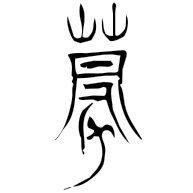 金文 bronze · 戰國晚期.晉
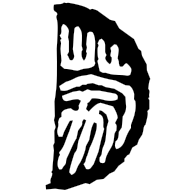 戰國文字 Warring States · 戰國.秦
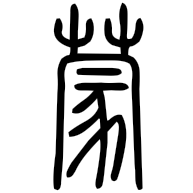 篆文 seal
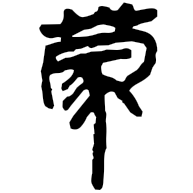 隸書 clerical · 西漢
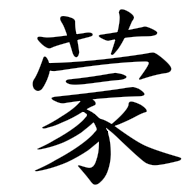 楷書 regular
Legge's note (1882)
Legge's title for the hexagram: youthful inexperience and ignorance.
IV. As Kun shows us plants struggling from beneath the surface, Măng suggests to us the small and undeveloped appearance which they then present; and hence it came to be the symbol of youthful inexperience and ignorance. The object of the hexagram is to show how such a condition should be dealt with by the parent and ruler, whose authority and duty are represented by the second and sixth, the two undivided lines. All between the first and last sentences of the Thwan must be taken as an oracular response received by the party divining on the subject of enlightening the youthful ignorant. This accounts for its being more than usually enigmatical, and for its being partly rhythmical. See Appendix I, in loc. The subject of the first line, weak, and at the bottom of the figure, is in the grossest ignorance. Let him be punished. If punishment avail to loosen the shackles and manacles from the mind, well; if not, and punishment be persevered with, the effect will be bad. On the subject of the second line, strong, and in the central place, devolves the task of enlightening the ignorant; and we have him discharging it with forbearance and humility. In proof of his generosity, it is said that ‘he receives,’ or learns from, even weak and ignorant women. He appears also as ‘a son’ taking the place of his father. The third line is weak, and occupies an odd place belonging properly to an undivided line; nor is its place in the centre. All these things give the subject of it so bad a character. The fourth line is far from both the second and sixth, and can get no help from its correlate,—the first line, weak as itself. What good can be done with or by the subject of it? The fifth line is in the place of honour, and has for its correlate the strong line in the second place. Being weak in itself, it is taken as the symbol of a simple lad, willing to be taught. The topmost line is strong, and in the highest place. It is natural, but unwise, in him to use violence in carrying on his educational measures. A better course is suggested to him.
Sources
- Chinese text: 周易, 維基文庫, page (revision 10645379); the text is public domain, the site's edits CC BY-SA 4.0.
- English: James Legge, The Yî King, Sacred Books of the East vol. XVI, Oxford 1882 (public domain), where this hexagram is “Măng”.
- Glyph images: 小學堂 字形演變, Academia Sinica (CC0 1.0).
- Pinyin: Unihan (Unicode License v3) with this site's readings for the classical cases. English gloss, relations, the idiom glosses, the English of the chronicle passages and the plain reading: this site.