- The 64
- Hexagram 61
61 中孚 Inner Sincerity
兌 Lake below, 巽 Wind above
Wind over the lake, and the figure hollow in the middle: inner sincerity, truth that reaches even pigs and fish. The text says it is good, that the great stream can be crossed, and that firmness is advantageous.
Tap a line of the figure to see where it leads when it changes. Cast for a question of your own. New here? What the I Ching is, coming from tarot.
This site's reading
卦辭 豚魚吉,利涉大川,利貞: pigs and fish, good; advantageous to cross the great stream; firmness advantageous. Sincerity that reaches the least responsive creatures; the crossing is on a hollow boat.
彖 The commentary: the yielding within and the firm central; pleased and gentle; sincerity transforms the state. Pigs and fish are good because trust reaches even them; crossing the stream is riding a hollow wooden boat; sincerity with firmness answers heaven.
大象 Wind over the lake: the noble person deliberates lawsuits and delays executions. Sincerity in judgment is slowness to condemn.
爻 The lines: measured, good; anything else and no rest; a crane calls in the shade and its young answer, I have a fine cup and will share it with you; finding a match, now drumming, now stopping, now weeping, now singing; the moon nearly full, a horse loses its mate, no blame; sincerity that binds, no blame; and at the top the cock's crow rising to heaven, firmness and yet evil. The second line is the book's most quoted on trust: the crane heard, the cup shared.
If your question is about
- A relationship
- The crane and its young (line 2): sincerity answered, the cup shared. Not the drumming and weeping (line 3), nor the cock's crow (line 6).
- Work
- Trust that reaches even pigs and fish (the Judgment) moves the whole state; deliberate slowly and condemn late (the Image).
- A decision
- Cross; the boat is hollow and sincere. Keep it measured (line 1), not loud (line 6).
- No line changing
- Inner sincerity as a state: the hollow centre kept. Trust binds (line 5); it does not need to climb to heaven.
Written from the text above and checked against it by Lun (2026-10-24). It is a way of reading the hexagram, not a prediction.
The text, with Legge
Judgment 卦辭
中孚:豚魚吉,利涉大川,利貞。
Kung Fû (moves even) pigs and fish, and leads to good fortune. There will be advantage in crossing the great stream. There will be advantage in being firm and correct. (Legge, 1882)
Commentary on the Judgment 彖
中孚,柔在內而剛得中。說而巽,孚,乃化邦也。豚魚吉,信及豚魚也。利涉大川,乘木舟虛也。中孚以利貞,乃應乎天也。
The Image 大象
澤上有風,中孚;君子以議獄緩死。
The six lines
Line 1 初九
虞吉,有它不燕。
The first line, undivided, shows its subject resting (in himself). There will be good fortune. If he sought to any other, he would not find rest. (Legge, 1882)
The Image 小象
初九虞吉,志未變也。
Changing, this line leads to 59 渙 Huàn.
Line 2 九二
鳴鶴在陰,其子和之,我有好爵,吾與爾靡之。
The second line, undivided, shows its subject (like) the crane crying out in her hidden retirement, and her young ones responding to her. (It is as if it were said), ‘I have a cup of good spirits,’ (and the response were), ‘I will partake of it with you.’ (Legge, 1882)
The Image 小象
其子和之,中心愿也。
Changing, this line leads to 42 益 Yì.
Line 3 六三
得敵,或鼓或罷,或泣或歌。
The third line, divided, shows its subject having met with his mate. Now he beats his drum, and now he leaves off. Now he weeps, and now he sings. (Legge, 1882)
The Image 小象
可鼓或罷,位不當也。
Changing, this line leads to 9 小畜 Xiǎo Chù.
Line 4 六四
月既望,馬匹亡,无咎。
The fourth line, divided, shows its subject (like) the moon nearly full, and (like) a horse (in a chariot) whose fellow disappears. There will be no error. (Legge, 1882)
The Image 小象
馬匹亡,絕類上也。
Changing, this line leads to 10 履 Lǚ.
Line 5 九五
有孚攣如,无咎。
The fifth line, undivided, shows its subject perfectly sincere, and linking (others) to him in closest union. There will be no error. (Legge, 1882)
The Image 小象
有孚攣如,位正當也。
Changing, this line leads to 41 損 Sǔn.
Line 6 上九
翰音登于天,貞凶。
The topmost line, undivided, shows its subject in chanticleer (trying to) mount to heaven. Even with firm correctness there will be evil. (Legge, 1882)
The Image 小象
翰音登于天,何可長也。
Changing, this line leads to 60 節 Jié.
Related hexagrams
Where the name comes from
中
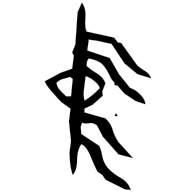 甲骨文 oracle bone · 商
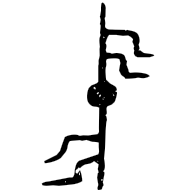 金文 bronze · 商代晚期
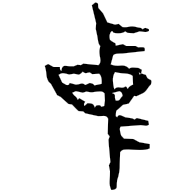 戰國文字 Warring States · 春秋晚期或戰國早期.晉
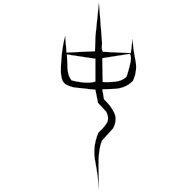 篆文 seal
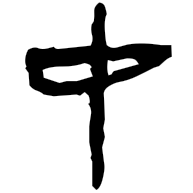 隸書 clerical · 秦
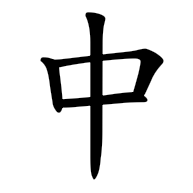 楷書 regular
孚
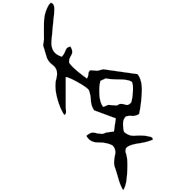 甲骨文 oracle bone · 商
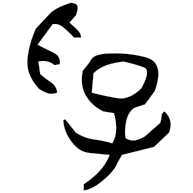 金文 bronze · 西周早期
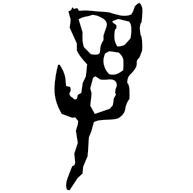 戰國文字 Warring States · 戰國.晉
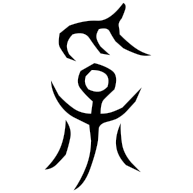 篆文 seal
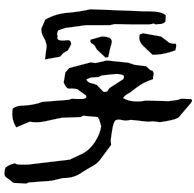 隸書 clerical · 東漢
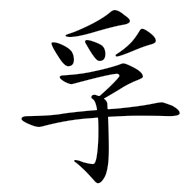 楷書 regular
Legge's note (1882)
Legge's title for the hexagram: Inmost Sincerity.
LXI. Kung Fû, the name of this hexagram, may be represented in English by ‘Inmost Sincerity.’ It denotes the highest quality of man, and gives its possessor power so that he prevails with spiritual beings, with other men, and with the lower creatures. It is the subject of the ‘Doctrine of the Mean’ from the 21st chapter onwards, where Remusat rendered it by ‘la perfection,’ ‘la perfection morale,’ and Intorcetta and his coadjutors by ‘vera solidaque perfectio.’ The lineal figure has suggested to the Chinese commentators, from the author of the first Appendix, two ideas in it which deserve to be pointed out. There are two divided lines in the centre and two undivided below them and above them. The divided lines in the centre are held to represent the heart or mind free from all pre-occupation, without any consciousness of self; and the undivided lines, on each side of it, in the centre of the constituent trigrams are held to denote the solidity of the virtue of one so free from selfishness. There is no unreality in it, not a single flaw. The ‘Daily Lecture’ at the conclusion of its paraphrase of the Thwan refers to the history of the ancient Shun, and the wonderful achievements of his virtue. The authors give no instance of the affecting of ‘pigs and fishes’ by sincerity, and say that these names are symbolical of men, the rudest and most unsusceptible of being acted on. The Text says that the man thus gifted with sincerity will succeed in the most difficult enterprises. Remarkable is the concluding sentence that he must be firm and correct. Here, as elsewhere throughout the Yî, there comes out the practical character which has distinguished the Chinese people and their best teaching all along the line of history. The translation of paragraph 1 is according to the view approved by the Khang-hsî editors. The ordinary view makes the other to whom the subject of line 1 looks or might look to be the subject of 4; but they contend that, excepting in the case of 3 and 6, the force of correlation should be discarded from the study of this hexagram; for the virtue of sincerity is all centred in itself, thence derived and thereby powerful. For paragraph 2, see Appendix III, Section i, 42. It is in rhyme, and I have there rendered it in rhyme. The ‘young ones of the crane’ are represented by line 1. In the third and fourth sentences we have the symbolism of two men brought together by their sympathy in virtue. The subject of the paragraph is the effect of sincerity. The ‘mate’ of line 3 is 6. The principle of correlation comes in. Sincerity, not left to itself, is influenced from without, and hence come the changes and uncertainty in the state and moods of the subject of the line. Line 4 is weak, and in its correct place. The subject of it has discarded the correlate in 1, and hastens on to the confidence of the ruler in 5, being symbolised as the moon nearly full. The other symbol of the horse whose fellow has disappeared has reference to the discarding of the subject of 1. Anciently chariots and carriages were drawn by four horses, two outsides and two insides. Lines 1 and 4 were a pair of these; but 1 disappears here from the team, and 4 goes on and joins 5. Line 5 is strong and central, in the ruler’s place. Its subject must be the sage on the throne, whose sincerity will go forth and bind all in union with himself. Line 6 should be divided, but is undivided; and coming after 5, what can the subject of it do? His efforts will be ineffectual, and injurious to himself. He is symbolised by a cock—literally, ‘the plumaged voice.’ But a cock is not fitted to fly high, and in attempting to do so will only suffer hurt.
Sources
- Chinese text: 周易, 維基文庫, page (revision 10647425); the text is public domain, the site's edits CC BY-SA 4.0.
- English: James Legge, The Yî King, Sacred Books of the East vol. XVI, Oxford 1882 (public domain), where this hexagram is “Kung Fû”.
- Glyph images: 小學堂 字形演變, Academia Sinica (CC0 1.0).
- Pinyin: Unihan (Unicode License v3) with this site's readings for the classical cases. English gloss, relations, the idiom glosses, the English of the chronicle passages and the plain reading: this site.