- The 64
- Hexagram 10
10 履 Treading
兌 Lake below, 乾 Heaven above
Treading on the tiger's tail, and it does not bite: conduct, the way one steps. The text says it gets through; the whole hexagram is about how to walk where the danger is.
Tap a line of the figure to see where it leads when it changes. Cast for a question of your own. New here? What the I Ching is, coming from tarot.
This site's reading
卦辭 Seven characters: tread on the tiger's tail, it does not bite the man, it gets through. The tiger is there; the counsel is not to avoid it but to step rightly.
彖 The commentary: the yielding treads on the firm (柔履剛), pleased and responding to Heaven, which is why the tiger does not bite. Firm, central and correct, treading the ruler's place without guilt (不疚): that is light.
大象 Heaven above, the lake below: the noble person distinguishes high and low and settles the people's will. Treading rightly is knowing one's place in the order.
爻 The lines: plain treading, going on without blame; a level, easy road, good for the quiet recluse who stays firm; the one-eyed who thinks he sees and the lame who thinks he walks, treading on the tiger's tail and bitten, a soldier playing great lord; the tiger's tail again, trembling with caution, and good at the end; resolute treading, firm and in peril; and at the top looking back over the whole way trodden and weighing it, greatly good. The third line is the fall; the fourth is the same step taken with fear.
If your question is about
- A relationship
- Step carefully where the other is touchy (the tiger's tail); fear is the fourth line's virtue, bravado the third's fall.
- Work
- Keep your place in the order and tread plainly; the quiet steady road (line 2) is the good one. Boldness past ability is bitten.
- A decision
- Go, with apprehension. Resolute treading is perilous even when correct (line 5); look back over the whole course before the last step.
- No line changing
- Conduct as a standing condition: you walk beside the tiger and will keep walking. Caution is not a phase here.
Written from the text above and checked against it by Lun (2026-10-24). It is a way of reading the hexagram, not a prediction.
The text, with Legge
Judgment 卦辭
履虎尾,不咥人,亨。
(Lî suggests the idea of) one treading on the tail of a tiger, which does not bite him. There will be progress and success. (Legge, 1882)
Commentary on the Judgment 彖
履,柔履剛也。說而應乎乾,是以履虎尾,不咥人,亨,利貞。剛中正,履帝位而不疚,光明也。
The Image 大象
上天下澤,履;君子以辨上下,定民志。
The six lines
Line 1 初九
素履,往无咎。
The first line, undivided, shows its subject treading his accustomed path. If he go forward, there will be no error. (Legge, 1882)
The Image 小象
素履之往,獨行願也。
Changing, this line leads to 6 訟 Sòng.
Line 2 九二
履道坦坦,幽人貞吉。
The second line, undivided, shows its subject treading the path that is level and easy;—a quiet and solitary man, to whom, if he be firm and correct, there will be good fortune. (Legge, 1882)
The Image 小象
幽人貞吉,中不自亂也。
Changing, this line leads to 25 无妄 Wú Wàng.
Line 3 六三
眇能視,跛能履,履虎尾,咥人,凶。武人為于大君。
The third line, divided, shows a one-eyed man (who thinks he) can see; a lame man (who thinks he) can walk well; one who treads on the tail of a tiger and is bitten. (All this indicates) ill fortune. We have a (mere) bravo acting the part of a great ruler. (Legge, 1882)
The Image 小象
眇能視,不足以有明也。跛能履,不足以與行也。咥人之凶,位不當也。武人為于大君,志剛也。
Changing, this line leads to 1 乾 Qián.
Line 4 九四
履虎尾,愬愬終吉。
The fourth line, undivided, shows its subject treading on the tail of a tiger. He becomes full of apprehensive caution, and in the end there will be good fortune. (Legge, 1882)
The Image 小象
愬愬終吉,志行也。
Changing, this line leads to 61 中孚 Zhōng Fú.
Line 5 九五
夬履,貞厲。
The fifth line, undivided, shows the resolute tread of its subject. Though he be firm and correct, there will be peril. (Legge, 1882)
The Image 小象
夬履貞厲,位正當也。
Changing, this line leads to 38 睽 Kuí.
Line 6 上九
視履考詳,其旋元吉。
The sixth line, undivided, tells us to look at (the whole course) that is trodden, and examine the presage which that gives. If it be complete and without failure, there will be great good fortune. (Legge, 1882)
The Image 小象
元吉在上,大有慶也。
Changing, this line leads to 58 兌 Duì.
Related hexagrams
Where the name comes from
履
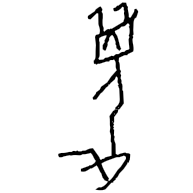 甲骨文 oracle bone · 商
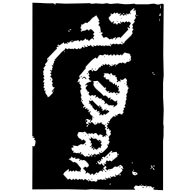 金文 bronze · 西周中期
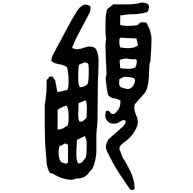 戰國文字 Warring States · 戰國.燕
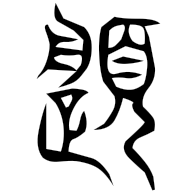 篆文 seal
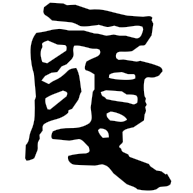 隸書 clerical · 西漢
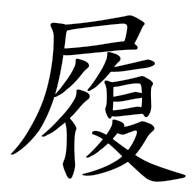 楷書 regular
Legge's note (1882)
Legge's title for the hexagram: treading (propriety).
X. The character giving its name to the hexagram plays an important part also in the symbolism; and this may be the reason why it does not, as the name, occupy the first place in the Thwan. Looking at the figure, we see it is made up of the trigrams Tui, representing a marsh, and Khien, representing the sky. Tui is a yin trigram, and its top line is divided. Below Khien, the great symbol of strength, it may readily suggest the idea of treading on a tiger’s tail, which was an old way of expressing what was hazardous (Shû V, xxv, 2). But what suggests the statement that ‘the tiger does not bite the treader?’ The attribute of Tui is pleased satisfaction. Of course such an attribute could not be predicated of one who was in the fangs of a tiger. The coming scatheless out of such danger further suggests the idea of ‘progress and success’ in the course which king Wăn had in his mind. And according to Appendix VI, that course was ‘propriety,’ the observance of all the rules of courtesy. On these, as so many stepping-stones, one may tread safely amid scenes of disorder and peril. Line 1 is an undivided line in an odd place; giving us the ideas of activity, firmness, and correctness. One so characterised will act rightly. Line 2 occupies the middle place of the trigram, which is supposed to symbolise a path cut straight and level along the hill-side, or over difficult ground. Line 5 is not a proper correlate, and hence the idea of the subject of 2 being ‘a quiet and solitary man.’ Line 3 is neither central nor in an even place, which would be proper to it. But with the strength of will which the occupant of an odd place should possess, he goes forward with the evil results so variously emblemed. The editors of the imperial edition, in illustration of the closing sentence, refer to Analects VII, x. Line 4 is in contiguity with 5, whose subject is in the place of authority; but he occupies the place proper to a weak or divided line, and hence he bethinks himself, and goes softly. Beneath the symbolism under line 5, lies the principle that the most excellent thing in ‘propriety’ is humility. And the subject of the line, which is strong and central, will not be lacking in this, but bear in mind that the higher he is exalted, the greater may be his fall. What is said on line 6 is good, but is only a truism. The whole course has been shown; if every step has been right and appropriate, the issue will be very good.
Sources
- Chinese text: 周易, 維基文庫, page (revision 10647513); the text is public domain, the site's edits CC BY-SA 4.0.
- English: James Legge, The Yî King, Sacred Books of the East vol. XVI, Oxford 1882 (public domain), where this hexagram is “Lî”.
- Glyph images: 小學堂 字形演變, Academia Sinica (CC0 1.0).
- Pinyin: Unihan (Unicode License v3) with this site's readings for the classical cases. English gloss, relations, the idiom glosses, the English of the chronicle passages and the plain reading: this site.