- The 64
- Hexagram 11
11 泰 Peace
乾 Heaven below, 坤 Earth above
Heaven below, earth above, each moving toward the other: peace, the small going and the great coming. The text says it is good and gets through; the lines say that no plain lacks its slope.
Tap a line of the figure to see where it leads when it changes. Cast for a question of your own. New here? What the I Ching is, coming from tarot.
This site's reading
卦辭 小往大來,吉亨: the small goes, the great comes; good, it gets through. Heaven's strength sits inside and rises, Earth's yielding sits outside and descends, so they meet.
彖 The commentary: heaven and earth join and all things pass through; above and below join and their wills are one. Yang within and yin without, strength within and compliance without, the noble person within and the small man without: the noble person's way grows, the small man's wanes.
大象 Heaven and earth joining: the ruler completes heaven and earth's way and assists what is fitting in them, to help the people on either hand. Peace is tended, not only enjoyed.
爻 The lines: pulling up grass, the roots come with it, going on is good; bearing with the rough, wading the river, not forgetting the distant, losing one's own party, holding the middle way; no plain without a slope, no going without a return, hard and firm and blameless, blessing in your food; fluttering down, not rich, with the neighbours, trusting; king Di Yi marrying off his younger sister, blessing, greatly good; and at the top the city wall fallen into the moat, no army to be used, orders from one's own town, firmness and regret. Peace runs from the first line to the sixth and ends.
If your question is about
- A relationship
- The two sides move toward each other; the third line is the counsel: no plain without a slope, so hold firm through the dip.
- Work
- Good and open; bear with the rough and keep the middle (line 2). The wall falls at the top: peace is not permanent.
- A decision
- Go; the way is open and the roots come up together (line 1). Build what the peace allows while it lasts.
- No line changing
- Peace that holds: heaven and earth in exchange. Tend it, assist what is fitting, and remember the slope.
Written from the text above and checked against it by Lun (2026-10-24). It is a way of reading the hexagram, not a prediction.
The text, with Legge
Judgment 卦辭
泰:小往大來,吉亨。
In Thâi (we see) the little gone and the great come. (It indicates that) there will be good fortune, with progress and success. (Legge, 1882)
Commentary on the Judgment 彖
泰,小往大來,吉亨。則是天地交而萬物通也,上下交而其志同也。內陽而外陰,內健而外順,內君子而外小人,君子道長,小人道消也。
The Image 大象
天地交,泰;后以財成天地之道,輔相天地之宜,以左右民。
The six lines
Line 1 初九
拔茅茹以其彙,征吉。
The first line, undivided, suggests the idea of grass pulled up, and bringing with it other stalks with whose roots it is connected. Advance (on the part of its subject) will be fortunate. (Legge, 1882)
The Image 小象
拔茅征吉,志在外也。
Changing, this line leads to 46 升 Shēng.
Line 2 九二
包荒。用馮河,不遐遺;朋亡。得尚于中行。
The second line, undivided, shows one who can bear with the uncultivated, will cross the Ho without a boat, does not forget the distant, and has no (selfish) friendships. Thus does he prove himself acting in accordance with the course of the due Mean. (Legge, 1882)
The Image 小象
包荒,得尚于中行,以光大也。
Changing, this line leads to 36 明夷 Míng Yí.
Line 3 九三
无平不陂,无往不復,艱貞无咎。勿恤其孚,于食有福。
The third line, undivided, shows that, while there is no state of peace that is not liable to be disturbed, and no departure (of evil men) so that they shall not return, yet when one is firm and correct, as he realises the distresses that may arise, he will commit no error. There is no occasion for sadness at the certainty (of such recurring changes); and in this mood the happiness (of the present) may be (long) enjoyed. (Legge, 1882)
The Image 小象
无往不復,天地際也。
Changing, this line leads to 19 臨 Lín.
Line 4 六四
翩翩,不富以其鄰;不戒以孚。
The fourth line, divided, shows its subject fluttering (down);—not relying on his own rich resources, but calling in his neighbours. (They all come) not as having received warning, but in the sincerity (of their hearts). (Legge, 1882)
The Image 小象
翩翩不富,皆失實也。不戒以孚,中心願也。
Changing, this line leads to 34 大壯 Dà Zhuàng.
Line 5 六五
帝乙歸妹,以祉,元吉。
The fifth line, divided, reminds us of (king) Tî-yî’s (rule about the) marriage of his younger sister. By such a course there is happiness and there will be great good fortune. (Legge, 1882)
The Image 小象
以祉,元吉。中以行願也。
Changing, this line leads to 5 需 Xū.
Line 6 上六
城復于隍,勿用師,自邑告命,貞吝。
The sixth line, divided, shows us the city wall returned into the moat. It is not the time to use the army. (The subject of the line) may, indeed, announce his orders to the people of his own city; but however correct and firm he may be, he will have cause for regret. (Legge, 1882)
The Image 小象
城復于隍,其命亂也。
Changing, this line leads to 26 大畜 Dà Chù.
Words that came from it
Phrases a billion people use today began as clauses of this hexagram.
- 否極泰來
- when 否 reaches its end, 泰 arrives. The commonest of all: after the worst, things turn. It is made of the names of hexagrams 11 and 12, which are each other turned upside down. From the name.
- 三陽開泰
- three yang lines open 泰. The New Year greeting: 泰 has three yang lines below three yin, the first month's hexagram in the calendar. From the name.
In history
The 左傳 and 國語, the chronicles of the sixth to fifth centuries BC, record real casts of the Changes and what came of them. One of them gave this hexagram.
486 BC: 趙鞅 of 晉, through 陽虎, on marching to rescue 鄭 from 宋
Asked: Should 晉 go to the aid of 鄭? The stalks gave 11 泰 with line 5 changing, to 5 需.
宋方吉不可與也.微子啟.帝乙之.元子也.宋.鄭.甥舅也.祉.祿也.若帝乙之元子.歸妹而有吉祿.我安得吉焉.Three turtle readings had already warned against saving 鄭. 陽虎 then cast with the Changes and read the fifth line of 泰, '帝乙 gives his daughter in marriage, with blessing and great fortune'. 宋 descends from 帝乙's eldest son 微子, and 宋 and 鄭 are kin by marriage; if the blessing is 宋's, how can it be ours?
趙鞅 called off the campaign. 晉 did not march against 宋; the next year 趙鞅 took his army against 齊 instead.
左傳 哀公九年, 維基文庫 (revision 7908334). The line text 帝乙歸妹 is in the received 泰 六五. The page's punctuation splits 帝乙之.元子也.
The chronicles' diviners read from oracle texts of their own time; where their words match our clause text the note says so, and where they do not, it says that. None of this is a claim that the text foretold the event.
In the calendar
In the Han dynasty's 卦氣 tradition, which lays the hexagrams over the year, 泰 is one of the twelve sovereign hexagrams 消息卦: it governs the month that begins at 雨水, rain water, and runs until 春分 (spring equinox), the first month of the traditional year, the month of 寅. Three yang below three yin: 三陽開泰, the New Year greeting.
The calendar is a later tradition about the hexagrams, not part of the text above.
Related hexagrams
Where the name comes from
泰
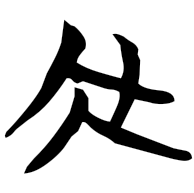 戰國文字 Warring States · 戰國.楚
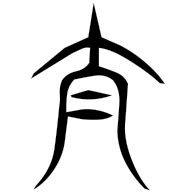 篆文 seal
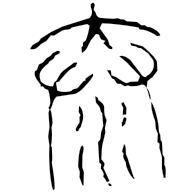 隸書 clerical · 秦
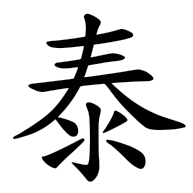 楷書 regular
Legge's note (1882)
Legge's title for the hexagram: .
XI. The language of the Thwan has reference to the form of Thâi, with the three strong lines of Khien below, and the three weak lines of Khwăn above. The former are ‘the great,’ active and vigorous; the latter are ‘the small,’ inactive and submissive. But where have the former ‘come’ from, and whither are the latter ‘gone?’ In many editions of the Yî beneath the hexagram of Thâi here, there appears that of Kwei Mei, the 54th in order (==), which becomes Thâi, if the third and fourth lines exchange places. But in the notes on the Thwan, in the first Appendix, on hexagram 6, I have spoken of the doctrine of ‘changing figures,’ and intimated my disbelief of it. The different hexagrams arose necessarily by the continued manipulation of the undivided and divided lines, and placing them each over itself and over the other. When king Wăn wrote these Thwan, he was taking the 64 hexagrams, as they were ready to his hand, and not forming one from another by any process of divination. The ‘gone’ and ‘come’ are merely equivalent to ‘below’ and ‘above,’ in the lower trigram or in the upper. A course in which the motive forces are represented by the three strong, and the opposing by the three weak lines, must be progressive and successful. Thâi is called the hexagram of the first month of the year, the first month of the natural spring, when for six months, through the fostering sun and genial skies, the processes of growth will be going on. The symbolism of paragraph 1 is suggested by the three strong lines of Khien all together, and all possessed by the same instinct to advance. The movement of the first will be supported by that of the others, and be fortunate. The second line is strong, but in an even place. This is supposed to temper the strength of its subject; which is expressed by the first of his characteristics. But the even place is the central; and it is responded to by a proper correlate in the fifth line above. Hence come all the symbolism of the paragraph and the auspice of good fortune implied in it. Beneath the symbolism in paragraph 3 there lies the persuasion of the constant change that is taking place in nature and in human affairs. As night succeeds to day, and winter to summer, so calamity may be expected to follow prosperity, and decay the flourishing of a state. The third is the last of the lines of Khien, by whose strength and activity the happy state of Thâi has been produced. Another aspect of things may be looked for; but by firmness and correctness the good estate of the present may be long continued. According to the treatise on the Thwan, the subjects of the fourth and other upper lines are not ‘the small returning’ as opponents of the strong lines below, as is generally supposed; but as the correlates of those lines, of one heart and mind with them to maintain the state of Thâi, and giving them, humbly but readily, all the help in their power. Tî-yî, the last sovereign but one of the Yin dynasty, reigned from B.C. 1191 to 1155; but what was the history of him and his sister here referred to we do not know. P. Regis assumes that he gave his sister in marriage to the lord of Kâu, known in subsequent time as king Wăn, and that she was the famous Thâi-sze;— contrary to all the evidence I have been able to find on the subject. According to Khăng-ȝze, Tî-yî was the first to enact a law that daughters of the royal house, in marrying princes of the states, should be in subjection to them, as if they were not superior to them in rank. Here line 5, while occupying the place of dignity and authority in the hexagram, is yet a weak line in the place of a strong one; and its subject, accordingly, humbly condescends to his strong and proper correlate in line 2. The course denoted by Thâi has been run; and will be followed by one of a different and unhappy character. The earth dug from the moat had been built up to form a protecting wall; but it is now again fallen into the ditch. War will only aggravate the evil; and however the ruler may address good proclamations to himself and the people of his capital, the coming evil cannot be altogether averted.
Sources
- Chinese text: 周易, 維基文庫, page (revision 2106138); the text is public domain, the site's edits CC BY-SA 4.0.
- English: James Legge, The Yî King, Sacred Books of the East vol. XVI, Oxford 1882 (public domain), where this hexagram is “Thâi”.
- Glyph images: 小學堂 字形演變, Academia Sinica (CC0 1.0).
- Pinyin: Unihan (Unicode License v3) with this site's readings for the classical cases. English gloss, relations, the idiom glosses, the English of the chronicle passages and the plain reading: this site.