- The 64
- Hexagram 15
15 謙 Modesty
艮 Mountain below, 坤 Earth above
A mountain hidden inside the earth: modesty, greatness that does not show. The text says it gets through and that the noble person brings it to completion; every line of this hexagram is good.
Tap a line of the figure to see where it leads when it changes. Cast for a question of your own. New here? What the I Ching is, coming from tarot.
This site's reading
卦辭 謙:亨,君子有終. Modesty gets through; the noble person has an end, that is, completes what he begins. It is the only hexagram whose six lines all turn out well.
彖 The commentary: heaven's way sends down and shines; earth's way is low and rises. Heaven diminishes the full and adds to the modest, earth alters the full and flows to the modest, spirits harm the full and bless the modest, people hate the full and love the modest. Modest and honoured, it shines; low, it cannot be passed over.
大象 A mountain in the earth: the noble person takes from the much and adds to the little, weighing things to make the giving even (稱物平施). Modesty here is an act of levelling, not a mood.
爻 The lines: the modest, modest noble person crosses the great stream, good; modesty that is heard of, firm and good; the noble person modest in his labour, completes, good; nothing unfavourable in showing modesty; not rich, with the neighbours, and force against the arrogant is fine; and at the top modesty heard of, and the army sent against one's own towns. Even the force in the last two lines is modesty's: correcting what will not level.
If your question is about
- A relationship
- The quiet mountain: greatness that does not advertise. Modesty heard of (line 2) is the good kind; it still allows firmness (line 5).
- Work
- Labour without display and complete the work (line 3): this is the hexagram where that is rewarded in every line.
- A decision
- Yes, modestly; even the great stream crosses on it (line 1). Level the uneven; do not claim the mountain.
- No line changing
- A standing modesty, and the one hexagram with no bad line. Keep weighing and evening; nothing needs to turn.
Written from the text above and checked against it by Lun (2026-10-24). It is a way of reading the hexagram, not a prediction.
The text, with Legge
Judgment 卦辭
謙:亨,君子有終。
Khien indicates progress and success. The superior man, (being humble as it implies), will have a (good) issue (to his undertakings). (Legge, 1882)
Commentary on the Judgment 彖
謙,亨,天道下濟而光明,地道卑而上行。天道虧盈而益謙,地道變盈而流謙,鬼神害盈而福謙,人道惡盈而好謙。謙尊而光,卑而不可逾,君子之終也。
The Image 大象
地中有山,謙;君子以裒多益寡,稱物平施。
The six lines
Line 1 初六
謙謙君子,用涉大川,吉。
The first line, divided, shows us the superior man who adds humility to humility. (Even) the great stream may be crossed with this, and there will be good fortune. (Legge, 1882)
The Image 小象
謙謙君子,卑以自牧也。
Changing, this line leads to 36 明夷 Míng Yí.
Line 2 六二
鳴謙,貞吉。
The second line, divided, shows us humility that has made itself recognised. With firm correctness there will be good fortune. (Legge, 1882)
The Image 小象
鳴謙貞吉,中心得也。
Changing, this line leads to 46 升 Shēng.
Line 3 九三
勞謙君子,有終吉。
The third line, undivided, shows the superior man of (acknowledged) merit. He will maintain his success to the end, and have good fortune. (Legge, 1882)
The Image 小象
勞謙君子,萬民服也。
Changing, this line leads to 2 坤 Kūn.
Line 4 六四
无不利,撝謙。
The fourth line, divided, shows one, whose action would be in every way advantageous, stirring up (the more) his humility. (Legge, 1882)
The Image 小象
无不利撝謙;不違則也。
Changing, this line leads to 62 小過 Xiǎo Guò.
Line 5 六五
不富,以其鄰,利用侵伐,无不利。
The fifth line, divided, shows one who, without being rich, is able to employ his neighbours. He may advantageously use the force of arms. All his movements will be advantageous. (Legge, 1882)
The Image 小象
利用侵伐,征不服也。
Changing, this line leads to 39 蹇 Jiǎn.
Line 6 上六
鳴謙,利用行師,征邑國。
The sixth line, divided, shows us humility that has made itself recognised. The subject of it will with advantage put his hosts in motion; but (he will only) punish his own towns and state. (Legge, 1882)
The Image 小象
鳴謙,志未得也。可用行師,征邑國也。
Changing, this line leads to 52 艮 Gèn.
Words that came from it
Phrases a billion people use today began as clauses of this hexagram.
- 謙謙君子
- the modest, modest gentleman. The stock description of a courteous, self-effacing man. From line 1: 謙謙君子.
In history
The 左傳 and 國語, the chronicles of the sixth to fifth centuries BC, record real casts of the Changes and what came of them. One of them gave this hexagram.
537 BC: 莊叔 (叔孫得臣), at the birth of his son 叔孫豹 (穆子)
Asked: What is this son's fate? The stalks gave 36 明夷 with line 1 changing, to 15 謙.
是將行.而歸為子祀.以讒人入.其名曰牛.卒以餒死.卜楚丘 read the first line of 明夷, the wounded bird flying with drooping wings and the traveller who eats nothing for three days: the boy would go into exile, return to head the family's sacrifices, bring in a slanderer named 牛, and in the end die of hunger. Fire below the mountain burns it, and burnt words are slander.
叔孫豹 fled to 齊, came back to lead the 叔孫 house, and fathered a son there named 豎牛. In 538 BC 豎牛 isolated the sick old man and starved him to death.
左傳 昭公五年, 維基文庫 (revision 10445713). Told in retrospect, after 叔孫豹's death; the year is that of the passage, the cast was made decades earlier. The reading quotes the received line text of 明夷 初九.
The chronicles' diviners read from oracle texts of their own time; where their words match our clause text the note says so, and where they do not, it says that. None of this is a claim that the text foretold the event.
Related hexagrams
Where the name comes from
謙
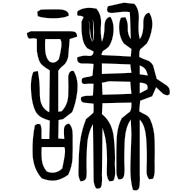 篆文 seal
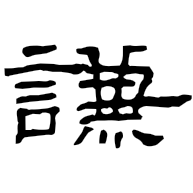 隸書 clerical · 東漢
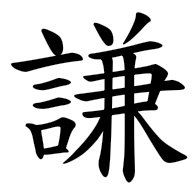 楷書 regular
Legge's note (1882)
Legge's title for the hexagram: .
XV. An essay on humility rightly follows that on abundant possessions. The third line, which is a whole line amid five others divided, occupying the topmost place in the lower trigram, is held by the Khang-hsî editors and many others to be ‘the lord of the hexagram,’ the representative of humility, strong, but abasing itself. There is nothing here in the text to make us enter farther on the symbolism of the figure. Humility is the way to permanent success. A weak line, at the lowest place of the figure, is the fitting symbol of the superior man adding humility to humility. Line 2 is weak, central, and in its proper place, representing a humility that has ‘crowed;’ that is, has proclaimed itself. Line 3 is strong, and occupies an odd (its proper) place. It is ‘the lord of the hexagram,’ to whom all represented by the lines above and below turn. Line 4 is weak and in its proper position. Its subject is sure to be successful and prosperous, but being so near the fifth line, he should still use the greatest precaution. All men love and honour humility, in itself and without the adjuncts which usually command obedience and respect. Hence his neighbours follow the ruler in the fifth line, though he may not be very rich or powerful. His humility need not keep him from asserting the right, even by force of arms. The subject of the sixth line, which is weak, is outside the game, so to speak, that has been played out. He will use force, but only within his own sphere and to assert what is right. He will not be aggressive.
Sources
- Chinese text: 周易, 維基文庫, page (revision 2106142); the text is public domain, the site's edits CC BY-SA 4.0.
- English: James Legge, The Yî King, Sacred Books of the East vol. XVI, Oxford 1882 (public domain), where this hexagram is “Khien”.
- Glyph images: 小學堂 字形演變, Academia Sinica (CC0 1.0).
- Pinyin: Unihan (Unicode License v3) with this site's readings for the classical cases. English gloss, relations, the idiom glosses, the English of the chronicle passages and the plain reading: this site.