- The 64
- Hexagram 21
21 噬嗑 Chewing Through
震 Thunder below, 離 Fire above
Something between the jaws that must be bitten through: an obstacle, and the force to clear it. The text says it gets through and that the use of the law is advantageous.
Tap a line of the figure to see where it leads when it changes. Cast for a question of your own. New here? What the I Ching is, coming from tarot.
This site's reading
卦辭 亨。利用獄: it gets through; advantageous to use the prison, that is, the law. The hexagram is a mouth with a thing in it; the only way on is to chew.
彖 The commentary: a thing in the jaws is called chewing through, and chewing through gets through. Firm and yielding divided, movement and brightness, thunder and lightning joined and shown. The yielding line gains the centre and rises; though not in its proper place, using the law is advantageous.
大象 Thunder and lightning: the former kings made the penalties clear and set the laws straight. Clearing an obstacle is done in the open, by rule.
爻 The lines: feet in the stocks, toes lost, no blame; biting soft meat and losing the nose, no blame; biting dried meat and meeting poison, small regret, no blame; biting dried meat on the bone and getting the metal arrow, hard and firm, good; biting dried meat and getting yellow gold, firm and in peril, no blame; and at the top a cangue on the neck, ears lost, evil. The first and last lines are the punished; the middle four are the biter, and the meat gets harder as the reward grows.
If your question is about
- A relationship
- An obstacle between you that will not dissolve; bite through it, openly and by fair rule. The first offence is light, the last is deaf.
- Work
- Enforce. Make the penalty clear and the rule straight (the Image); the hard cases (lines 4 and 5) pay best if you stay firm.
- A decision
- Act, decisively and lawfully; the thing in the jaws does not pass on its own. Expect poison on the way (line 3).
- No line changing
- The obstacle as a standing state. Chew; the text has no softer counsel, only the warning not to end in the cangue.
Written from the text above and checked against it by Lun (2026-10-24). It is a way of reading the hexagram, not a prediction.
The text, with Legge
Judgment 卦辭
噬嗑:亨。利用獄。
Shih Ho indicates successful progress (in the condition of things which it supposes). It will be advantageous to use legal constraints. (Legge, 1882)
Commentary on the Judgment 彖
頤中有物,曰噬嗑,噬嗑而亨。剛柔分,動而明,雷電合而章。柔得中而上行,雖不當位,利用獄也。
The Image 大象
雷電噬嗑;先王以明罰敕法。
The six lines
Line 1 初九
屨校滅趾,无咎。
The first line, undivided, shows one with his feet in the stocks and deprived of his toes. There will be no error. (Legge, 1882)
The Image 小象
屨校滅趾,不行也。
Changing, this line leads to 35 晉 Jìn.
Line 2 六二
噬膚滅鼻,无咎。
The second line, divided, shows one biting through the soft flesh, and (going on to) bite off the nose. There will be no error. (Legge, 1882)
The Image 小象
噬膚滅鼻,乘剛也。
Changing, this line leads to 38 睽 Kuí.
Line 3 六三
噬昔肉,遇毒;小吝,无咎。
The third line, divided, shows one gnawing dried flesh, and meeting with what is disagreeable. There will be occasion for some small regret, but no (great) error. (Legge, 1882)
The Image 小象
遇毒,位不當也。
Changing, this line leads to 30 離 Lí.
Line 4 九四
噬乾胏,得金矢,利艱貞,吉。
The fourth line, undivided, shows one gnawing the flesh dried on the bone, and getting the pledges of money and arrows. It will be advantageous to him to realise the difficulty of his task and be firm,—in which case there will be good fortune. (Legge, 1882)
The Image 小象
利艱貞吉,未光也。
Changing, this line leads to 27 頤 Yí.
Line 5 六五
噬乾肉,得黃金,貞厲,无咎。
The fifth line, divided, shows one gnawing at dried flesh, and finding the yellow gold. Let him be firm and correct, realising the peril (of his position). There will be no error. (Legge, 1882)
The Image 小象
貞厲无咎,得當也。
Changing, this line leads to 25 无妄 Wú Wàng.
Line 6 上九
何校滅耳,凶。
The sixth line, undivided, shows one wearing the cangue, and deprived of his ears. There will be evil. (Legge, 1882)
The Image 小象
何校滅耳,聰不明也。
Changing, this line leads to 51 震 Zhèn.
Related hexagrams
Where the name comes from
噬
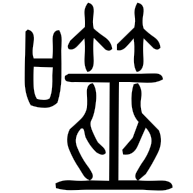 篆文 seal
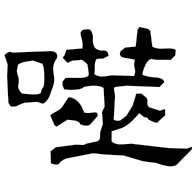 隸書 clerical · 東漢
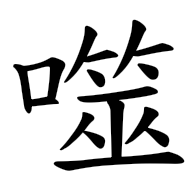 楷書 regular
嗑
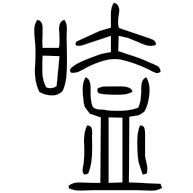 篆文 seal
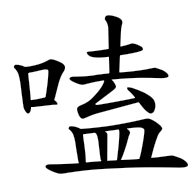 楷書 regular
Legge's note (1882)
Legge's title for the hexagram: Union by gnawing.
XXI. Shih Ho means literally ‘Union by gnawing.’ We see in the figure two strong lines in the first and last places, while all the others, with the exception of the fourth, are divided. This suggests the idea of the jaws and the mouth between them kept open by something in it. Let that be gnawed through and the mouth will close and the jaws come together. So in the body politic. Remove the obstacles to union, and high and low will come together with a good understanding. And how are those obstacles to be removed? By force, emblemed by the gnawing; that is, by legal constraints. And these are sure to be successful. The auspice of the figure is favourable. There will be success. Lines 1 and 6 are much out of the game or action described in the figure. Hence they are held to represent parties receiving punishment, while the other lines represent parties inflicting it. The punishment in line 1 is that of the stocks, administered for a small offence, and before crime has made much way. But if the ‘depriving’ of the toes is not merely keeping them in restraint, but cutting them off, as the Chinese character suggests, the punishment appears to a western reader too severe. Line 2 is weak, appropriately therefore in an even place, and it is central besides. The action therefore of its subject should be effective; and this is shown by the ‘biting through the soft flesh,’ an easy thing. Immediately below, however, is a strong offender represented by the strong line, and before he will submit it is necessary to ‘bite off his nose;’ for punishment is the rule;— it must be continued and increased till the end is secured. Line 3 is weak, and in an even place. The action of its subject will be ineffective; and is emblemed by the hard task of gnawing through dried flesh, and encountering, besides, what is distasteful and injurious in it. But again comes in the consideration that here punishment is the rule, and the auspice is not all bad. Of old, in a civil case, both parties, before they were heard, brought to the court an arrow (or a bundle of arrows), in testimony of their rectitude, after which they were heard; in a criminal case, they in the same way deposited each thirty pounds of gold, or some other metal. See the Official Book of Kâu, 27. 14, 15. The subject of the fourth line’s getting those pledges indicates his exercising his judicial functions; and what he gnaws through indicates their difficulty. Moreover, though the line is strong, it is in an even place; and hence comes the lesson of caution. The fifth line represents ‘the lord of judgment.’ As it is a weak line, he will be disposed to leniency; and his judgments will be correct. This is declared by his finding the ‘yellow metal;’ for yellow is one of the five ‘correct’ colours. The position is in the centre and that of rule; but the line being weak, a caution is given, as under the previous line. The action of the figure has passed, and still we have, in the subject of line 6, one persisting in wrong, a strong criminal, wearing the cangue, and deaf to counsel. Of course the auspice is evil.
Sources
- Chinese text: 周易, 維基文庫, page (revision 10645753); the text is public domain, the site's edits CC BY-SA 4.0.
- English: James Legge, The Yî King, Sacred Books of the East vol. XVI, Oxford 1882 (public domain), where this hexagram is “Shih Ho”.
- Glyph images: 小學堂 字形演變, Academia Sinica (CC0 1.0).
- Pinyin: Unihan (Unicode License v3) with this site's readings for the classical cases. English gloss, relations, the idiom glosses, the English of the chronicle passages and the plain reading: this site.