- The 64
- Hexagram 48
48 井 The Well
巽 Wind below, 坎 Water above
Wood drawing water up: the well, the source that stays while the town moves. The text says the well is neither lost nor gained, that people come and go to it, and that the rope that stops short and the broken jug are the danger.
Tap a line of the figure to see where it leads when it changes. Cast for a question of your own. New here? What the I Ching is, coming from tarot.
This site's reading
卦辭 改邑不改井,无喪无得,往來井井。汔至亦未繘井。羸其瓶,凶: the town may be moved, the well is not; nothing lost, nothing gained; those who come and go draw from it. Almost there but the rope not yet to the water; the jug cracked: evil. The well is permanent; the failures are the drawer's.
彖 The commentary: entering the water and raising the water is the well; the well nourishes and is not exhausted. The town changes and the well does not because the firm is central. The rope that falls short has not yet achieved; the cracked jug is why it is evil.
大象 Water above wood: the noble person comforts the people and encourages them to help one another. The well is for everyone who comes.
爻 The lines: a muddy well no one drinks, an old well no bird visits; a well that leaks to the fish through a cracked jug; a well cleaned and not drunk, which pains the heart, it could be drawn, and if the king were wise all would share the blessing; the well lined, no blame; a clear well, cold spring, drink; and at the top the well drawn and uncovered, sincerity, greatly good. The lines are the well's repair, from mud to the uncovered mouth.
If your question is about
- A relationship
- The source is constant; the failures are the rope and the jug. A well cleaned and not drunk (line 3) is the saddest line here.
- Work
- Nourish and do not exhaust (the commentary). Line the well, clear it, and leave it uncovered for everyone (line 6).
- A decision
- Tend what is permanent rather than move the town; finish the rope's length, or the almost-there is evil.
- No line changing
- The well as a state: there whether or not it is used. Keep it clear, keep it open, keep the jug whole.
Written from the text above and checked against it by Lun (2026-10-24). It is a way of reading the hexagram, not a prediction.
The text, with Legge
Judgment 卦辭
井:改邑不改井,无喪无得,往來井井。汔至亦未繘井。羸其瓶,凶。
(Looking at) Ȝing, (we think of) how (the site of) a town may be changed, while (the fashion of) its wells undergoes no change. (The water of a well) never disappears and never receives (any great) increase, and those who come and those who go can draw and enjoy the benefit. If (the drawing) have nearly been accomplished, but, before the rope has quite reached the water, the bucket is broken, this is evil. (Legge, 1882)
Commentary on the Judgment 彖
巽乎水而上水,井;井養而不窮也。改邑不改井,乃以剛中也。汔至亦未繘井,未有功也。羸其瓶,是以凶也。
The Image 大象
木上有水,井;君子以勞民勸相。
The six lines
Line 1 初六
井泥不食,舊井无禽。
The first line, divided, shows a well so muddy that men will not drink of it; or an old well to which neither birds (nor other creatures) resort. (Legge, 1882)
The Image 小象
井泥不食,下也。舊井无禽,時舍也。
Changing, this line leads to 5 需 Xū.
Line 2 九二
井谷射鮒,瓮敝漏。
The second line, undivided, shows a well from which by a hole the water escapes and flows away to the shrimps (and such small creatures among the grass), or one the water of which leaks away from a broken basket. (Legge, 1882)
The Image 小象
井谷射鮒,无與也。
Changing, this line leads to 39 蹇 Jiǎn.
Line 3 九三
井渫不食,為我心惻,可用汲,王明,並受其福。
The third line, undivided, shows a well, which has been cleared out, but is not used. Our hearts are sorry for this, for the water might be drawn out and used. If the king were (only) intelligent, both he and we might receive the benefit of it. (Legge, 1882)
The Image 小象
井渫不食,行惻也。求王明,受福也。
Changing, this line leads to 29 坎 Kǎn.
Line 4 六四
井甃,无咎。
The fourth line, divided, shows a well, the lining of which is well laid. There will be no error. (Legge, 1882)
The Image 小象
井甃无咎,修井也。
Changing, this line leads to 28 大過 Dà Guò.
Line 5 九五
井冽,寒泉食。
The fifth line, undivided, shows a clear, limpid well, (the waters from) whose cold spring are (freely) drunk. (Legge, 1882)
The Image 小象
寒泉之食,中正也。
Changing, this line leads to 46 升 Shēng.
Line 6 上六
井收勿幕,有孚元吉。
The topmost line, divided, shows (the water from) the well brought to the top, which is not allowed to be covered. This suggests the idea of sincerity. There will be great good fortune. (Legge, 1882)
The Image 小象
元吉在上,大成也。
Changing, this line leads to 57 巽 Xùn.
Related hexagrams
Where the name comes from
井
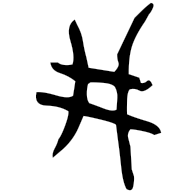 甲骨文 oracle bone · 商
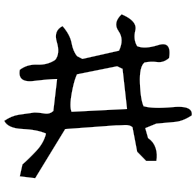 金文 bronze · 商代晚期
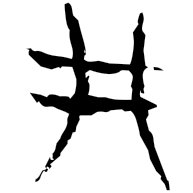 戰國文字 Warring States · 春秋晚期或戰國早期.晉
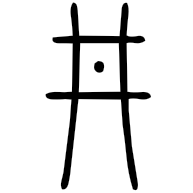 篆文 seal
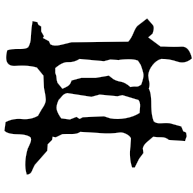 隸書 clerical · 西漢
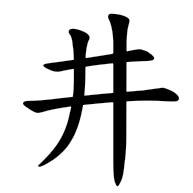 楷書 regular
Legge's note (1882)
Legge's title for the hexagram: a well.
XLVIII. Ȝing, which gives its name to this hexagram, is the symbol of a well. The character originally was pictorial (FF), intended to represent a portion of land, divided into nine parts, the central portion belonging to the government, and being cultivated by the joint labour of the eight families settled on the other divisions. In the centre of it, moreover, was a well, which was the joint property of all the occupants. What is said on Ȝing might be styled ‘Moralisings on a well,’ or ‘Lessons to be learned from a well for the good order and government of a country.’ What a well is to those in its neighbourhood, and indeed to men in general, that is government to a people. If rulers would only rightly appreciate the principles of government handed down from the good ages of the past, and faithfully apply them to the regulation of the present, they would be blessed themselves and their people with them. In the Thwan we have the well, substantially the same through many changes of society; a sure source of dependance to men, for their refreshment and for use in their cultivation of the ground. Its form is what I have seen in the plains of northern China; what may be seen among ourselves in many places in Europe. It is deep, and the water is drawn up by a vessel let down from the top; and the value of the well depends on the water being actually raised. And so the principles of government must be actually carried out. Line 1, being weak, and at the very bottom of the figure, suggests, or is made to suggest, the symbolism of it. Many men in authority are like such a well; corrupt, useless, unregarded. Line 2 is strong, and might very well symbolise an active spring, ever feeding the well and, through it, the ground and its cultivators; but it is in an inappropriate place, and has no proper correlate. Its cool waters cannot be brought to the top. So important is it that the ministers of a country should be able and willing rightly to administer its government. In the account of the ancient Shun it is stated that he once saved his life by an opening in the lining of a well. Line 3 is a strong line, in its proper place; and must represent an able minister or officer. But though the well is clear, no use is made of it. I do not find anything in the figure that can be connected with this fact. The author was wise beyond his lines. After the first sentence of the paragraph, the duke of Kâu ceases from his function of making emblems; reflects and moralises. Line 4 is weak, but in its proper place. Its subject is not to be condemned, but neither is he to be praised. He takes care of himself, but does nothing for others. Line 5 is strong, and in its right place. The place is that of the ruler, and suggests the well, full of clear water, which is drawn up, and performs its useful work. Such is the good Head of government to his people. Line 6 is in its proper place, but weak. If the general idea of the figure was different, a bad auspice might be drawn from it. But here we see in it the symbol of the water drawn up, and the top uncovered so that the use of the well is free to all. Then the mention of ‘sincerity’ suggests the inexhaustibleness of the elemental supply.
Sources
- Chinese text: 周易, 維基文庫, page (revision 10645240); the text is public domain, the site's edits CC BY-SA 4.0.
- English: James Legge, The Yî King, Sacred Books of the East vol. XVI, Oxford 1882 (public domain), where this hexagram is “Ȝing”.
- Glyph images: 小學堂 字形演變, Academia Sinica (CC0 1.0).
- Pinyin: Unihan (Unicode License v3) with this site's readings for the classical cases. English gloss, relations, the idiom glosses, the English of the chronicle passages and the plain reading: this site.