- The 64
- Hexagram 30
30 離 Radiance
離 Fire below, 離 Fire above
Fire over fire: radiance, brightness that clings to what it burns. The text says firmness is advantageous and it gets through, and adds the strangest counsel in the book: keep a docile cow.
Tap a line of the figure to see where it leads when it changes. Cast for a question of your own. New here? What the I Ching is, coming from tarot.
This site's reading
卦辭 利貞。亨。畜牝牛,吉: firmness advantageous; it gets through; rearing a cow is good. Fire needs fuel and clings to it; brightness needs something mild to rest on.
彖 The commentary: 離 is to cling (麗). Sun and moon cling to the sky, grains and plants cling to the earth; doubled brightness clings to what is correct and transforms the world. The yielding clings to the centre, so it gets through; hence the cow.
大象 Brightness arising twice: the great person continues the light and shines on the four quarters. The second fire is the point: light kept going.
爻 The lines: steps in confusion, treading with reverence, no blame; yellow brightness, greatly good; the brightness of the setting sun, and if one does not drum on the pot and sing, there is the lament of great age, evil; it comes abruptly, burning, dying, cast away; tears in torrents and grieving sighs, good; and at the top the king sends him out to fight, with merit, taking the chief and not the crowd, no blame. The middle lines are fire's two ends: the declining sun and the sudden blaze.
If your question is about
- A relationship
- Brightness that clings: keep something mild to rest on (the cow). Line 3's evening calls for singing, not lament; line 4's blaze burns out.
- Work
- Carry the light on (the Image); be the yellow, central brightness of line 2. Sudden fires (line 4) die as fast as they come.
- A decision
- Yes with firmness and something gentle to cling to. Take the chief, not the crowd (line 6): aim the fire.
- No line changing
- Radiance as a state: light continued. Feed it mildly and evenly; the sun declines (line 3), so sing while it is high.
Written from the text above and checked against it by Lun (2026-10-24). It is a way of reading the hexagram, not a prediction.
The text, with Legge
Judgment 卦辭
離:利貞。亨。畜牝牛,吉。
Lî indicates that, (in regard to what it denotes), it will be advantageous to be firm and correct, and that thus there will be free course and success. Let (its subject) also nourish (a docility like that of) the cow, and there will be good fortune. (Legge, 1882)
Commentary on the Judgment 彖
離,麗也;日月麗乎天,百穀草木麗乎土,重明以麗乎正,乃化成天下。柔麗乎中正,故亨;是以畜牝牛吉也。
The Image 大象
明兩作離,大人以繼明照于四方。
The six lines
Line 1 初九
履錯然,敬之无咎。
The first line, undivided, shows one ready to move with confused steps. But he treads at the same time reverently, and there will be no mistake. (Legge, 1882)
The Image 小象
履錯之敬,以辟咎也。
Changing, this line leads to 56 旅 Lǚ.
Line 2 六二
黃離,元吉。
The second line, divided, shows its subject in his place in yellow. There will be great good fortune. (Legge, 1882)
The Image 小象
黃離元吉,得中道也。
Changing, this line leads to 14 大有 Dà Yǒu.
Line 3 九三
日昃之離,不鼓缶而歌,則大耋之差,凶。
The third line, undivided, shows its subject in a position like that of the declining sun. Instead of playing on his instrument of earthenware, and singing to it, he utters the groans of an old man of eighty. There will be evil. (Legge, 1882)
The Image 小象
日昃之離,何可久也。
Changing, this line leads to 21 噬嗑 Shì Kè.
Line 4 九四
突如其來如,焚如,死如,棄如。
The fourth line, undivided, shows the manner of its subject’s coming. How abrupt it is, as with fire, with death, to be rejected (by all)! (Legge, 1882)
The Image 小象
突如其來如,无所容也。
Changing, this line leads to 22 賁 Bì.
Line 5 六五
出涕沱若,戚嗟若,吉。
The fifth line, divided, shows its subject as one with tears flowing in torrents, and groaning in sorrow. There will be good fortune. (Legge, 1882)
The Image 小象
六五之吉,離王公也。
Changing, this line leads to 13 同人 Tóng Rén.
Line 6 上九
王用出征,有嘉折首,獲匪其醜,无咎。
The topmost line, undivided, shows the king employing its subject in his punitive expeditions. Achieving admirable (merit), he breaks (only) the chiefs (of the rebels). Where his prisoners were not their associates, he does not punish. There will be no error. (Legge, 1882)
The Image 小象
王用出征,以正邦也。
Changing, this line leads to 55 豐 Fēng.
Words that came from it
Phrases a billion people use today began as clauses of this hexagram.
- 突如其來
- arriving all of a sudden. The common phrase for anything that comes out of nowhere. From line 4: 突如其來如.
Related hexagrams
Where the name comes from
離
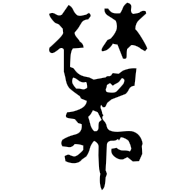 戰國文字 Warring States · 戰國.晉
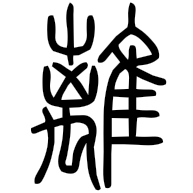 篆文 seal
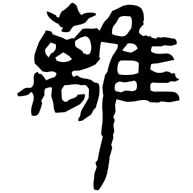 隸書 clerical · 秦
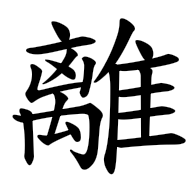 楷書 regular
Legge's note (1882)
Legge's title for the hexagram: brightness; adhering to.
XXX. Lî is the name of the trigram representing fire and light, and the sun as the source of both of these. Its virtue or attribute is brightness, and by a natural metaphor intelligence. But Lî has also the meaning of inhering in, or adhering to, being attached to. Both these significations occur in connexion with the hexagram, and make it difficult to determine what was the subject of it in the minds of the authors. If we take the whole figure as expressing the subject, we have, as in the treatise on the Thwan, ‘a double brightness,’ a phrase which is understood to denominate the ruler. If we take the two central lines as indicating the subject, we have weakness, dwelling with strength above and below. In either case there are required from the subject a strict adherence to what is correct, and a docile humility. On the second member of the Thwan Khăng-ȝze says:—‘The nature of the ox is docile, and that of the cow is much more so. The subject of the hexagram adhering closely to what is correct, he must be able to act in obedience to it, as docile as a cow, and then there will be good fortune.’ Line 1 is strong, and at the bottom of the trigram for fire, the nature of which is to ascend. Its subject therefore will move upwards, and is in danger of doing so coarsely and vehemently. But the lowest line has hardly entered into the action of the figure, and this consideration operates to make him reverently careful of his movements; and there is no error. Line 2 is weak, and occupies the centre. Yellow is one of the five correct colours, and here symbolises the correct course to which the subject of the line adheres. Line 3 is at the top of the lower trigram, whose light may be considered exhausted, and suggests the symbol of the declining sun. The subject of the line should accept the position, and resign himself to the ordinary amusements which are mentioned, but he groans and mourns instead. His strength interferes with the lowly contentment which he should cherish. The strength of line 4, and its being in an even place, make its subject appear in this unseemly manner, disastrous to himself. Line 5 is in the place of honour, and central. But it is weak, as is its correlate. Its position between the strong 4 and 6 fills its subject with anxiety and apprehension, that express themselves as is described. But such demonstrations are a proof of his inward adherence to right and his humility. There will be good fortune. Line 6, strong and at the top of the figure, has the intelligence denoted by its trigrams in the highest degree, and his own proper vigour. Through these his achievements are great, but his generous consideration is equally conspicuous, and he falls into no error.
Sources
- Chinese text: 周易, 維基文庫, page (revision 10646424); the text is public domain, the site's edits CC BY-SA 4.0.
- English: James Legge, The Yî King, Sacred Books of the East vol. XVI, Oxford 1882 (public domain), where this hexagram is “Lî”.
- Glyph images: 小學堂 字形演變, Academia Sinica (CC0 1.0).
- Pinyin: Unihan (Unicode License v3) with this site's readings for the classical cases. English gloss, relations, the idiom glosses, the English of the chronicle passages and the plain reading: this site.