- The 64
- Hexagram 33
33 遯 Withdrawal
艮 Mountain below, 乾 Heaven above
A mountain under heaven, and heaven drawing back: withdrawal, the timely retreat. The text says it gets through, with a small advantage in firmness; the lines grade retreats from the caught tail to the fat, free one.
Tap a line of the figure to see where it leads when it changes. Cast for a question of your own. New here? What the I Ching is, coming from tarot.
This site's reading
卦辭 亨。小利貞: it gets through; small advantage in firmness. The yielding lines are rising from below; the strong ones withdraw before they are pushed.
彖 The commentary: it gets through by withdrawing. The firm line is in its place and answered, moving with the time; small advantage in firmness because the yielding is soaking in and growing. "Great is the meaning of withdrawal's time."
大象 Heaven with the mountain below it: the noble person keeps small men at a distance, not with hatred but with severity. Withdrawal is distance kept with dignity.
爻 The lines: the tail of the retreat, danger, do not go anywhere; held fast as by yellow ox-hide, nothing can loosen it; a bound withdrawal, sickness and danger, good only for keeping servants; a withdrawal despite fondness, good for the noble person, not for the small; an admirable withdrawal, firm and good; and at the top a fat withdrawal, nothing not advantageous. The further from the rising lines, the freer the retreat.
If your question is about
- A relationship
- Retreat in time and with dignity, severity without hatred (the Image). Fondness makes it hard (line 4); the caught tail (line 1) is too late.
- Work
- Withdraw before you are pushed; the small is growing. Do it admirably (line 5), not bound (line 3).
- A decision
- Leave, and leave well. The further and the earlier, the freer: the fat withdrawal of the top line.
- No line changing
- Withdrawal as a state: keep the distance, keep the severity, keep the dignity. Nothing here says return.
Written from the text above and checked against it by Lun (2026-10-24). It is a way of reading the hexagram, not a prediction.
The text, with Legge
Judgment 卦辭
遯:亨。小利貞。
Thun indicates successful progress (in its circumstances). To a small extent it will (still) be advantageous to be firm and correct. (Legge, 1882)
Commentary on the Judgment 彖
遯亨,遯而亨也。剛當位而應,與時行也。小利貞,浸而長也。遯之時義大矣哉!
The Image 大象
天下有山,遯;君子以遠小人,不惡而嚴。
The six lines
Line 1 初六
遯尾,厲,勿用有攸往。
The first line, divided, shows a retiring tail. The position is perilous. No movement in any direction should be made. (Legge, 1882)
The Image 小象
遯尾之厲,不往何災也。
Changing, this line leads to 13 同人 Tóng Rén.
Line 2 六二
執之用黃牛之革,莫之勝說。
The second line, divided, shows its subject holding (his purpose) fast as if by a (thong made from the) hide of a yellow ox, which cannot be broken. (Legge, 1882)
The Image 小象
執用黃牛,固志也。
Changing, this line leads to 44 姤 Gòu.
Line 3 九三
係遯,有疾厲,畜臣妾吉。
The third line, undivided, shows one retiring but bound,—to his distress and peril. (If he were to deal with his binders as in) nourishing a servant or concubine, it would be fortunate for him. (Legge, 1882)
The Image 小象
係遯之厲,有疾憊也。畜臣妾吉,不可大事也。
Changing, this line leads to 12 否 Pǐ.
Line 4 九四
好遯君子吉,小人否。
The fourth line, undivided, shows its subject retiring notwithstanding his likings. In a superior man this will lead to good fortune; a small man cannot attain to this. (Legge, 1882)
The Image 小象
君子好遯,小人否也。
Changing, this line leads to 53 漸 Jiàn.
Line 5 九五
嘉遯,貞吉。
The fifth line, undivided, shows its subject retiring in an admirable way. With firm correctness there will be good fortune. (Legge, 1882)
The Image 小象
嘉遯貞吉,以正志也。
Changing, this line leads to 56 旅 Lǚ.
Line 6 上九
肥遯,无不利。
The sixth line, undivided, shows its subject retiring in a noble way. It will be advantageous in every respect. (Legge, 1882)
The Image 小象
肥遯,无不利;无所疑也。
Changing, this line leads to 31 咸 Xián.
In the calendar
In the Han dynasty's 卦氣 tradition, which lays the hexagrams over the year, 遯 is one of the twelve sovereign hexagrams 消息卦: it governs the month that begins at 大暑, great heat, and runs until 處暑 (end of heat), the sixth month of the traditional year, the month of 未. Two yin lines; the yang 'retreats'.
The calendar is a later tradition about the hexagrams, not part of the text above.
Related hexagrams
Where the name comes from
遯
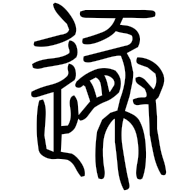 篆文 seal
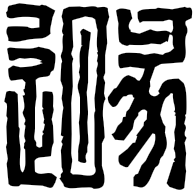 隸書 clerical
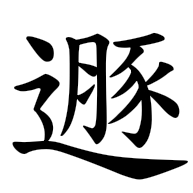 楷書 regular
Legge's note (1882)
Legge's title for the hexagram: retiring.
XXXIII. Thun is the hexagram of the sixth month; the yin influence is represented by two weak lines, and has made good its footing in the year. The figure thus suggested to king Wăn the growth of small and unprincipled men in the state, before whose advance superior men were obliged to retire. This is the theme of his essay,—how, ‘when small men multiply and increase in power, the necessity of the time requires superior men to withdraw before them.’ Yet the auspice of Thun is not all bad. By firm correctness the threatened evil may be arrested to a small extent. ‘A retiring tail’ seems to suggest the idea of the subject of the lines hurrying away, which would only aggravate the evil and danger of the time. ‘His purpose’ in line 2 is the purpose to withdraw. The weak 2 responds correctly to the strong 5, and both are central. The purpose therefore is symbolled as in the text. The ‘yellow’ colour of the ox is introduced because of its being ‘correct,’ and of a piece with the central place of the line. Line 3 has no proper correlate in 6; and its subject allows himself to be entangled and impeded by the subjects of 1 and 2. He is too familiar with them, and they presume, and fetter his movements;—compare Analects, 17. 25. He should keep them at a distance. Line 4 has a correlate in 1, and is free to exercise the decision belonging to its subject. The line is the first in Khien, symbolic of strength. In the Shû IV, v, Section 2. 9, the worthy Î Yin is made to say, ‘The minister will not for favour or gain continue in an office whose work is done;’ and the Khang-hsî editors refer to his words as an illustration of what is said on line 5. It has its correlate in 2, and its subject carries out the purpose to retire ‘in an admirable way.’ Line 6 is strong, and with no correlate to detain it in 3. Its subject vigorously and happily carries out the idea of the hexagram.
Sources
- Chinese text: 周易, 維基文庫, page (revision 10645108); the text is public domain, the site's edits CC BY-SA 4.0.
- English: James Legge, The Yî King, Sacred Books of the East vol. XVI, Oxford 1882 (public domain), where this hexagram is “Thun”.
- Glyph images: 小學堂 字形演變, Academia Sinica (CC0 1.0).
- Pinyin: Unihan (Unicode License v3) with this site's readings for the classical cases. English gloss, relations, the idiom glosses, the English of the chronicle passages and the plain reading: this site.