- The 64
- Hexagram 29
29 坎 The Pit
坎 Water below, 坎 Water above
Water over water: the pit doubled, danger repeated. The text says sincerity brings the heart through, and that acting on it has value; the way out of the defile is through it.
Tap a line of the figure to see where it leads when it changes. Cast for a question of your own. New here? What the I Ching is, coming from tarot.
This site's reading
卦辭 習坎:有孚,維心亨。行有尚: the repeated pit; with sincerity, only the heart gets through; action is honoured. The danger is not denied; the heart is told to keep its own course inside it.
彖 The commentary: repeated danger. Water flows and does not overfill, goes through danger and does not lose its faithfulness. The heart gets through because the firm is central; action has value because going on achieves. Heaven's danger cannot be climbed, earth's are mountains and rivers; kings and princes set dangers to guard their states. "Great is the use of the pit's time."
大象 Water arriving again and again: the noble person keeps virtue constant in action and practises the business of teaching. Repetition is the lesson and the method.
爻 The lines: the repeated pit, and into the hole within it, evil; the pit has danger, seek small gains; coming and going, pit after pit, danger with rest, into the hole, do not act; a jug of wine, a bowl of rice, a second in a plain pot, handed in through the window, in the end no blame; the pit not full, the level reached, no blame; and at the top bound with cords, set among thorns, three years without release, evil. The fourth line is the way: plain offerings through the window when the door is shut.
If your question is about
- A relationship
- Danger shared is water flowing: keep faith inside it (the Judgment). Plain offerings through the window (line 4) when nothing else gets in.
- Work
- Through, not around; seek small gains (line 2), keep constant practice (the Image). Do not act from the hole (line 3).
- A decision
- Act on sincerity, with the heart steady; the text honours it. But not from the bottom of the pit, and not by force.
- No line changing
- The pit as a state: danger that repeats. Flow like water, do not overfill, keep faith; teaching and practice are the Image's gift.
Written from the text above and checked against it by Lun (2026-10-24). It is a way of reading the hexagram, not a prediction.
The text, with Legge
Judgment 卦辭
習坎:有孚,維心亨。行有尚。
Khan, here repeated, shows the possession of sincerity, through which the mind is penetrating. Action (in accordance with this) will be of high value. (Legge, 1882)
Commentary on the Judgment 彖
習坎,重險也。水流而不盈,行險而不失其信。維心亨,乃以剛中也。行有尚,往有功也。天險不可升也,地險山川丘陵也,王公設險以守其國,坎之時用大矣哉!
The Image 大象
水洊至,習坎;君子以常德行,習教事。
The six lines
Line 1 初六
習坎,入于坎窞,凶。
The first line, divided, shows its subject in the double defile, and (yet) entering a cavern within it. There will be evil. (Legge, 1882)
The Image 小象
習坎入坎,失道凶也。
Changing, this line leads to 60 節 Jié.
Line 2 九二
坎有險,求小得。
The second line, undivided, shows its subject in all the peril of the defile. He will, however, get a little (of the deliverance) that he seeks. (Legge, 1882)
The Image 小象
求小得,未出中也。
Changing, this line leads to 8 比 Bǐ.
Line 3 六三
來之坎坎,險且枕,入于坎窞,勿用。
The third line, divided, shows its subject, whether he comes or goes (=descends or ascends), confronted by a defile. All is peril to him and unrest. (His endeavours) will lead him into the cavern of the pit. There should be no action (in such a case). (Legge, 1882)
The Image 小象
來之坎坎,終无功也。
Changing, this line leads to 48 井 Jǐng.
Line 4 六四
尊酒簋,貳用缶。内約自牖,終无咎。
The fourth line, divided, shows its subject (at a feast), with (simply) a bottle of spirits, and a subsidiary basket of rice, while (the cups and bowls) are (only) of earthenware. He introduces his important lessons (as his ruler’s) intelligence admits. There will in the end be no error. (Legge, 1882)
The Image 小象
樽酒簋貳,剛柔济也。
Changing, this line leads to 47 困 Kùn.
Line 5 九五
坎不盈,禔既平,无咎。
The fifth line, undivided, shows the water of the defile not yet full, (so that it might flow away); but order will (soon) be brought about. There will be no error. (Legge, 1882)
The Image 小象
坎不盈,中未大也。
Changing, this line leads to 7 師 Shī.
Line 6 上六
係用徽纆,寘于叢棘,三歲不得,凶。
The topmost line, divided, shows its subject bound with cords of three strands or two strands, and placed in the thicket of thorns. But in three years he does not learn the course for him to pursue. There will be evil. (Legge, 1882)
The Image 小象
上六失道,凶三歲也。
Changing, this line leads to 59 渙 Huàn.
Related hexagrams
Where the name comes from
坎
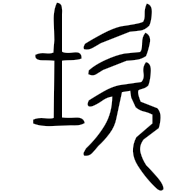 篆文 seal
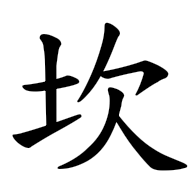 楷書 regular
Legge's note (1882)
Legge's title for the hexagram: a pit, a perilous defile.
XXIX. The trigram Khan, which is doubled to form this hexagram, is the lineal symbol of water. Its meaning, as a character, is ‘a pit,’ ‘a perilous cavity, or defile;’ and here and elsewhere in the Yî it leads the reader to think of a dangerous defile, with water flowing through it. It becomes symbolic of danger, and what the authors of the Text had in mind was to show how danger should be encountered, its effect on the mind, and how to get out of it. The trigram exhibits a strong central line, between two divided lines. The central represented to king Wăn the sincere honesty and goodness of the subject of the hexagram, whose mind was sharpened and made penetrating by contact with danger, and who acted in a manner worthy of his character. It is implied, though the Thwan does not say it, that he would get out of the danger. Line 1 is weak, at the bottom of the figure, and has no correlate above, no helper, that is, beyond itself. All these things render the case of its subject hopeless. He will by his efforts only involve himself more deeply in danger. Line 2 is strong, and in the centre. Its subject is unable, indeed, to escape altogether from the danger; but he does not involve himself more deeply in it like the subject of 1, and obtains some ease. Line 3 is weak, and occupies the place of a strong line. Its subject is in an evil case. Line 4 is weak, and will get no help from its correlate in 1. Its subject is not one who can avert the danger threatening himself and others. But his position is close to that of the ruler in 5, whose intimacy he cultivates with an unostentatious sincerity, symbolled by the appointments of the simple feast, and whose intelligence he cautiously enlightens. In consequence, there will be no error. The subject of line 5 is on the eve of extrication and deliverance. The waters of the defile will ere long have free vent and disappear, and the ground will be levelled and made smooth. The line is strong, in a proper place, and in the place of honour. The case of the subject of line 6 is hopeless. When danger has reached its highest point, there he is, represented by a weak line, and with no proper correlate below. The ‘thicket of thorns’ is taken as a metaphor for a prison; but if the expression has a history, I have been unable to find it.
Sources
- Chinese text: 周易, 維基文庫, page (revision 10646381); the text is public domain, the site's edits CC BY-SA 4.0.
- English: James Legge, The Yî King, Sacred Books of the East vol. XVI, Oxford 1882 (public domain), where this hexagram is “Khan”.
- Glyph images: 小學堂 字形演變, Academia Sinica (CC0 1.0).
- Pinyin: Unihan (Unicode License v3) with this site's readings for the classical cases. English gloss, relations, the idiom glosses, the English of the chronicle passages and the plain reading: this site.