- The 64
- Hexagram 57
57 巽 Wind
巽 Wind below, 巽 Wind above
Wind over wind: penetration, the gentle thing that gets in everywhere by repeating. The text says small success, that there is advantage in going somewhere, and that the great person should be seen.
Tap a line of the figure to see where it leads when it changes. Cast for a question of your own. New here? What the I Ching is, coming from tarot.
This site's reading
卦辭 小亨。利有攸往。利見大人: small success; advantageous to have somewhere to go; advantageous to see the great person. Wind achieves by persistence, and the Judgment keeps it modest.
彖 The commentary: wind doubled repeats the command; the firm is gentle in the central and correct place and its will is carried out; the yielding all comply with the firm. Hence small success, going, and the great person.
大象 Wind following wind: the noble person repeats his commands and carries out his business. The order is given again, not louder.
爻 The lines: advancing and retreating, a soldier's firmness is what is needed; wind under the bed, using scribes and shamans in numbers, good, no blame; repeated penetration, mean; regret gone, three kinds of game taken in the hunt; firm and good, regret gone, nothing not advantageous, no beginning but an end, three days before the day 庚 and three days after, good; and at the top wind under the bed, the axe and the money lost, firm and yet evil. Under the bed twice: once with help and good, once alone and lost.
If your question is about
- A relationship
- Gentle, repeated influence rather than a push; the fifth line's change comes with preparation before and after. Hesitating (line 1) needs a soldier's firmness.
- Work
- Repeat the command and carry it out (the Image). Small success at a time; the great person is the one to see.
- A decision
- Go, modestly; wind gets in by returning. Fix a day and prepare around it (line 5).
- No line changing
- Wind as a state: the same gentle pressure, again and again. Keep repeating; do not hide under the bed with the axe lost (line 6).
Written from the text above and checked against it by Lun (2026-10-24). It is a way of reading the hexagram, not a prediction.
The text, with Legge
Judgment 卦辭
巽:小亨。利有攸往。利見大人。
Sun intimates that (under the conditions which it denotes) there will be some little attainment and progress. There will be advantage in movement onward in whatever direction. It will be advantageous (also) to see the great man. (Legge, 1882)
Commentary on the Judgment 彖
重巽以申命,剛巽乎中正而志行。柔皆順乎剛,是以小亨,利有攸往,利見大人。
The Image 大象
隨風,巽;君子以申命行事。
The six lines
Line 1 初六
進退,利武人之貞。
The first line, divided, shows its subject (now) advancing, (now) receding. It would be advantageous for him to have the firm correctness of a brave soldier. (Legge, 1882)
The Image 小象
進退,志疑也。利武人之貞,志治也。
Changing, this line leads to 9 小畜 Xiǎo Chù.
Line 2 九二
巽在牀下,用史巫紛若,吉无咎。
The second line, undivided, shows the representative of Sun beneath a couch, and employing diviners and exorcists in a way bordering on confusion. There will be good fortune and no error. (Legge, 1882)
The Image 小象
紛若之吉,得中也。
Changing, this line leads to 53 漸 Jiàn.
Line 3 九三
頻巽,吝。
The third line, undivided, shows its subject penetrating (only) by violent and repeated efforts. There will be occasion for regret. (Legge, 1882)
The Image 小象
頻巽之吝,志窮也。
Changing, this line leads to 59 渙 Huàn.
Line 4 六四
悔亡,田獲三品。
The fourth line, divided, shows all occasion for repentance (in its subject) passed away. He takes game for its threefold use in his hunting. (Legge, 1882)
The Image 小象
田獲三品,有功也。
Changing, this line leads to 44 姤 Gòu.
Line 5 九五
貞吉悔亡,无不利。无初有終,先庚三日,後庚三日,吉。
The fifth line, undivided, shows that with firm correctness there will be good fortune (to its subject). All occasion for repentance will disappear, and all his movements will be advantageous. There may have been no (good) beginning, but there will be a (good) end. Three days before making any changes, (let him give notice of them); and three days after, (let him reconsider them). There will (thus) be good fortune. (Legge, 1882)
The Image 小象
九五之吉,位正中也。
Changing, this line leads to 18 蠱 Gǔ.
Line 6 上九
巽在牀下,喪其資斧,貞凶。
The sixth line, undivided, shows the representative of penetration beneath a couch, and having lost the axe with which he executed his decisions. However firm and correct he may (try to) be, there will be evil. (Legge, 1882)
The Image 小象
巽在牀下,上窮也。喪其資斧,正乎凶也。
Changing, this line leads to 48 井 Jǐng.
Related hexagrams
Where the name comes from
巽
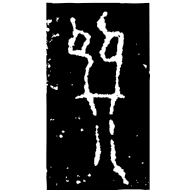 金文 bronze · 戰國早期.楚
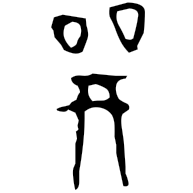 戰國文字 Warring States · 戰國.晉
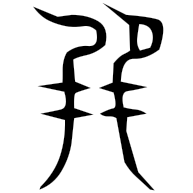 篆文 seal
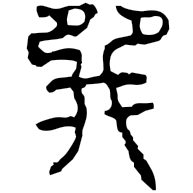 隸書 clerical · 西漢
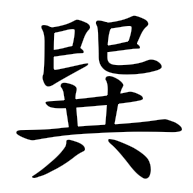 楷書 regular
Legge's note (1882)
Legge's title for the hexagram: penetration (wind).
LVII. With Sun as the fifth of the Fû-hsî trigrams we have become familiar. It symbolises both wind and wood; and has the attributes of flexibility (nearly allied to docility) and penetration. In this hexagram we are to think of it as representing wind with its penetrating power, finding its way into every corner and cranny. Confucius once said (Analects 12. 19):—‘The relation between superiors and inferiors is like that between the wind and the grass. The grass must bend when the wind blows upon it.’ In accordance with this, the subject of the hexagram must be understood as the influence and orders of government designed to remedy what is wrong in the people. The ‘Daily Lecture’ says that the upper trigram denotes the orders issuing from the ruler, and the lower the obedience rendered to them by the people; but this view is hardly borne out by the Text. But how is it that the figure represents merely ‘some little attainment?’ This is generally explained by taking the first line of the trigram as indicating what the subject of it can do. But over the weak first line are two strong lines, so that its subject can accomplish but little. The Khang-hsî editors, rejecting this view, contend that, the idea of the whole figure being penetration, line 1, the symbol of weakness and what is bad, will not be able to offer much resistance to the subjects of the other lines, which will enter and dispel its influence. They illustrate this from processes of nature, education, and politics; the effect they say is described as small, because the process is not to revolutionise or renew, but only to correct and improve. Such as it is, however, it requires the operation of the strong and virtuous, ‘the great man.’ Even all this criticism is not entirely satisfactory. Line 1 is weak, where it should be strong. The movements of its subject are expressive of perplexity. He wants vigour and decision. Line 2 is strong, and in the right place, and has a good auspice. Things are placed or hidden beneath a couch or bed; and the subject of the line appears as searching for them. He calls in divination to assist his judgment, and exorcists to expel for him what is bad. The work is great and difficult, so that he appears almost distracted by it; but the issue is good. For this successful explanation of the line, I am indebted to the Khang-hsî editors. The writer of the Text believed of course in divination and exorcism; which was his misfortune rather than his fault or folly. Line 3 is in the right place for a strong line. But its position at the top of the lower trigram is supposed to indicate the restlessness, and here the vehemence, of its subject. And 6 is no proper correlate. All the striving is ineffective, and there is occasion for regret. Line 4 is weak, as is its correlate in 1. But 4 is a proper place for a weak line, and it rests under the shadow of the strong and central 5. Hence the omens of evil are counteracted; and a good auspice is obtained. The game caught in hunting was divided into three portions:—the first for use in sacrifices; the second for the entertainment of visitors; and the third for the kitchen generally. A hunt which yielded enough for all these purposes was deemed very successful. On line 5 Khăng-ȝze says:—‘It is the seat of honour, and the place for the lord of Sun, from whom there issue all charges and commands. It is central and correct; we must find in its subject the qualities denoted by Sun in their greatest excellence. But those qualities are docility and accordance with what is right; and the advantage of firm correctness is insisted on. With this all will be right.’ With the concluding sentence compare the conclusion of the Thwan of hexagram 18. The evil that paragraph 6 concludes with would arise from the quality of Sun being carried to excess. I have followed the Khang-hsî editors in adopting a change of one character in the received Text.
Sources
- Chinese text: 周易, 維基文庫, page (revision 10644966); the text is public domain, the site's edits CC BY-SA 4.0.
- English: James Legge, The Yî King, Sacred Books of the East vol. XVI, Oxford 1882 (public domain), where this hexagram is “Sun”.
- Glyph images: 小學堂 字形演變, Academia Sinica (CC0 1.0).
- Pinyin: Unihan (Unicode License v3) with this site's readings for the classical cases. English gloss, relations, the idiom glosses, the English of the chronicle passages and the plain reading: this site.