- The 64
- Hexagram 1
1 乾 Heaven
乾 Heaven below, 乾 Heaven above
Six unbroken lines: pure initiative, the sky's own motion. The text says it works, and that it works only while it stays straight.
Tap a line of the figure to see where it leads when it changes. Cast for a question of your own. New here? What the I Ching is, coming from tarot.
This site's reading
卦辭 The Judgment is four characters, 元亨利貞: a great beginning, a getting-through, a benefit, and holding firm. Their oldest sense is a formula of the divination itself, four marks that say the undertaking is sound. Either way the counsel sits in the fourth word: the strength of this figure is kept by staying correct, not by pressing harder.
彖 The commentary widens it to the sky. Everything takes its start from this force; the sun's course sets the six positions in their times; and change here means each thing finding its own nature. The phrase to keep is 保合太和, harmony kept whole: power that preserves balance rather than overruns it.
大象 The Image is the line everyone knows: heaven moves without stopping, and the noble person, in the same way, keeps strengthening themselves without rest, 自強不息. It describes steadiness, not haste.
爻 The six lines follow a dragon upward: hidden and not yet to be used; appearing in the field; working all day and watchful at night; leaping, or staying in the deep; flying in the sky; and at last too high, with regret. Read your line as a stage on that climb; the sixth says what lies past the top. When all six change, the text adds that a flight of dragons with no head is good: strength with no one claiming to lead it.
If your question is about
- A relationship
- Strength that keeps its balance, not strength that presses. The climb has stages; do not try to be at the fifth line early.
- Work
- A beginning with real force behind it. Persist without haste and know your stage: hidden, appearing, working, leaping, flying.
- A decision
- Act, but from the stage you are actually in. Past the summit, going on is regret.
- No line changing
- All initiative and staying so. Keep correct and keep going; the question is pace, not direction.
Written from the text above and checked against it by Lun (2026-10-24). It is a way of reading the hexagram, not a prediction.
The text, with Legge
Judgment 卦辭
乾:元亨。利貞。
Khien (represents) what is great and originating, penetrating, advantageous, correct and firm. (Legge, 1882)
Commentary on the Judgment 彖
大哉乾元,萬物資始,乃統天。雲行雨施,品物流形,大明終始,六位時成。時乘六龍以御天,乾道變化,各正性命,保合大和,乃利貞。首出庶物,萬國咸寧。
The Image 大象
天行健,君子以自強不息。
Words of the Text 文言
元者,善之長也。亨者,嘉之會也。利者,義之和也。貞者,事之幹也。君子體仁足以長人,嘉會足以合禮,利物足以和義,貞固足以幹事。君子行此四德者,故曰:「乾,元、亨、利、貞。」 初九曰:「潛龍,勿用。」何謂也?子曰:「龍德而隱者也。不易乎世,不成乎名,遯世无悶,不見是而无悶,樂則行之,憂則違之,確乎其不可拔,潛龍也。」 九二曰:「見龍在田,利見大人。」何謂也?子曰:「龍德而正中者也。庸言之信,庸行之謹;閑邪存其誠,善世而不伐,德博而化。易曰:『見龍在田,利見大人。』君德也。」 九三曰:「君子終日乾乾,夕惕若,厲,无咎。」何謂也?子曰:「君子進德脩業。忠信,所以進德也;脩辭立其誠,所以居業也。知至至之,可與言幾也。知終終之,可與存義也。是故居上位而不驕,在下位而不憂,故乾乾因其時而惕,雖危无咎矣。」 九四曰:「或躍在淵,无咎。」何謂也?子曰:「上下无常,非為邪也。進退无恒,非離羣也。君子進德脩業,欲及時也。故无咎。」 九五曰:「飛龍在天,利見大人。」何謂也?子曰:「同聲相應,同氣相求;水流濕,火就燥,雲從龍,風從虎;聖人作而萬物覩;本乎天者親上,本乎地者親下,則各從其類也。」 上九曰:「亢龍,有悔。」何謂也?子曰:「貴而无位,高而无民,賢人在下位而无輔,是以動而有悔也。」 § 「潛龍勿用」,下也。 「見龍在田」,時舍也。 「終日乾乾」,行事也。 「或躍在淵」,自試也。 「飛龍在天」,上治也。 「亢龍有悔」,窮之災也。 「乾元用九」,天下治也。 § 「潛龍勿用」,陽氣潛藏。 「見龍在田」,天下文明。 「終日乾乾」,與時偕行。 「或躍在淵」,乾道乃革。 「飛龍在天」,乃位乎天德。 「亢龍有悔」,與時偕極。 「乾元用九」,乃見天則。 § 乾元者,始而亨者也。利貞者,性情也。乾始能以美利利天下,不言所利,大矣哉!大哉乾元,剛健中正,純粹精也。六爻發揮,旁通情也。時乘六龍,以御天也。雲行雨施,天下平也。 君子以成德為行,日可見之行也。潛之為言也,隱而未見,行而未成,是以君子弗用也。 君子學以聚之,問以辯之,寬以居之,仁以行之,易曰:「見龍在田,利見大人。」君德也。 九三,重剛而不中,上不在天,下不在田;故乾乾因其時而惕,雖危,无咎矣。 九四,重剛而不中,上不在天,下不在田,中不在人,故或之。或之者,疑之也,故无咎。 夫大人者,與天地合其德,與日月合其明,與四時合其序,與鬼神合其吉凶;先天而天弗違,後天而奉天時,天且弗違,而況於人乎?況於鬼神乎? 亢之為言也,知進而不知退,知存而不知亡,知得而不知喪;其唯聖人乎?知進退存亡而不失其正者,其唯聖人乎!
The six lines
Line 1 初九
潛龍勿用。
In the first (or lowest) line, undivided, (we see its subject as) the dragon lying hid (in the deep). It is not the time for active doing. (Legge, 1882)
The Image 小象
潛龍勿用,陽在下也。
Changing, this line leads to 44 姤 Gòu.
Line 2 九二
見龍在田,利見大人。
In the second line, undivided, (we see its subject as) the dragon appearing in the field. It will be advantageous to meet with the great man. (Legge, 1882)
The Image 小象
見龍在田,德施普也。
Changing, this line leads to 13 同人 Tóng Rén.
Line 3 九三
君子終日乾乾,夕惕若;厲,无咎。
In the third line, undivided, (we see its subject as) the superior man active and vigilant all the day, and in the evening still careful and apprehensive. (The position is) dangerous, but there will be no mistake. (Legge, 1882)
The Image 小象
終日乾乾,反復道也。
Changing, this line leads to 10 履 Lǚ.
Line 4 九四
或躍在淵,无咎。
In the fourth line, undivided, (we see its subject as the dragon looking) as if he were leaping up, but still in the deep. There will be no mistake. (Legge, 1882)
The Image 小象
或躍在淵,進无咎也。
Changing, this line leads to 9 小畜 Xiǎo Chù.
Line 5 九五
飛龍在天,利見大人。
In the fifth line, undivided, (we see its subject as) the dragon on the wing in the sky. It will be advantageous to meet with the great man. (Legge, 1882)
The Image 小象
飛龍在天,大人造也。
Changing, this line leads to 14 大有 Dà Yǒu.
Line 6 上九
亢龍,有悔。
In the sixth (or topmost) line, undivided, (we see its subject as) the dragon exceeding the proper limits. There will be occasion for repentance. (Legge, 1882)
The Image 小象
亢龍有悔,盈不可久也。
Changing, this line leads to 43 夬 Guài.
All lines 用九
見羣龍无首,吉。
(The lines of this hexagram are all strong and undivided, as appears from) the use of the number nine. If the host of dragons (thus) appearing were to divest themselves of their heads, there would be good fortune. (Legge, 1882)
The Image 小象
用九,天德不可為首也。
Words that came from it
Phrases a billion people use today began as clauses of this hexagram.
- 自強不息
- to keep strengthening oneself without rest. The motto of Tsinghua University and of a thousand school walls; the first half of the pair every Chinese schoolchild knows. From the Image 大象: 自強不息.
- 潛龍勿用
- the hidden dragon: do not act yet. Said of talent that is not yet its time; a stock phrase for lying low. From line 1: 潛龍勿用.
- 飛龍在天
- the dragon flying in the sky. The peak of a career or a reign; a name for the emperor's position. From line 5: 飛龍在天.
- 亢龍有悔
- the dragon that flies too high will regret it. A warning against overreach; a martial-arts move in Jin Yong's novels. From line 6: 亢龍,有悔.
- 群龍無首
- a crowd of dragons with no head. Today it means a leaderless rabble; in the text the headless dragons are a good sign. From the line for all six: 見羣龍无首,吉.
In history
The 左傳 and 國語, the chronicles of the sixth to fifth centuries BC, record real casts of the Changes and what came of them. One of them gave this hexagram.
660 BC: 魯桓公, before the birth of his son 季友 (成季)
Asked: What will this child be? The stalks gave 14 大有 with line 5 changing, to 1 乾.
同復于父,敬如君所。After the turtle oracle promised a son named 友 who would stand at the duke's right hand and prop up the ducal house, the stalks were also cast and gave 大有 moving to 乾. The reading: he will return to the standing of his father, and be honoured as if he were the ruler himself.
The boy was born with a mark on his hand read as 友 and named for it. He founded the 季孫 family, which ran 魯 for the next three centuries.
左傳 閔公二年, 維基文庫 (revision 2675997). Told in retrospect; the cast was made before 桓公's death in 694 BC, the year given is that of the passage. The reading quotes an oracle sentence not found in the received text of 大有.
The chronicles' diviners read from oracle texts of their own time; where their words match our clause text the note says so, and where they do not, it says that. None of this is a claim that the text foretold the event.
In the calendar
In the Han dynasty's 卦氣 tradition, which lays the hexagrams over the year, 乾 is one of the twelve sovereign hexagrams 消息卦: it governs the month that begins at 小滿, grain full, and runs until 夏至 (summer solstice), the fourth month of the traditional year, the month of 巳. All six lines yang; the height of light.
The calendar is a later tradition about the hexagrams, not part of the text above.
Related hexagrams
Where the name comes from
乾
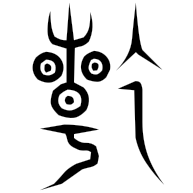 篆文 seal
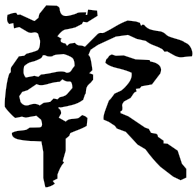 隸書 clerical · 秦
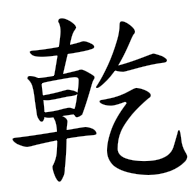 楷書 regular
Legge's note (1882)
Legge's title for the hexagram: .
The Text under each hexagram consists of one paragraph by king Wăn, explaining the figure as a whole, and of six (in the case of hexagrams 1 and 2, of seven) paragraphs by the duke of Kâu, explaining the individual lines. The explanatory notices introduced above to this effect will not be repeated. A double space will be used to mark off the portion of king Wăn from that of his son. Each hexagram consists of two of the trigrams of Fû-hsî, the lower being called ‘the inner,’ and the one above ‘the outer.’ The lines, however, are numbered from one to six, commencing with the lowest. To denote the number of it and of the sixth line, the terms for ‘commencing’ and ‘topmost’ are used. The intermediate lines are simply ‘second,’ ‘third,’ &c. As the lines must be either whole or divided, technically called strong and weak, yang and yin, this distinction is indicated by the application to them of the numbers nine and six. All whole lines are nine, all divided lines, six. Two explanations have been proposed of this application of these numbers. The Khien trigram, it is said, contains 3 strokes (==>), and the Khwăn 6 (== =). But the yang contains the yin in itself, and its representative number will be 3+6=9, while the yin, not containing the yang, will only have its own number or 6. This explanation, entirely arbitrary, is now deservedly abandoned. The other is based on the use of the ‘four Hsiang,’ or emblematic figures (the great or old yang, === the young yang, == == the old yin, and === the young yin). To these are assigned (by what process is unimportant for our present purpose) the numbers 9, 8, 7, 6. They were ‘the old yang,’ represented by 9, and ‘the old yin,’ represented by 6, that, in the manipulation of the stalks to form new diagrams, determined the changes of figure; and so 9 and 6 came to be used as the names of a yang line and a yin line respectively. This explanation is now universally acquiesced in. The nomenclature of first nine, nine two, &c., or first six, six two, &c., however, is merely a jargon; and I have preferred to use, instead of it, in the translation, in order to describe the lines, the names ‘undivided’ and ‘divided.’ I. Does king Wăn ascribe four attributes here to Khien, or only two? According to Appendix IV, always by Chinese writers assigned to Confucius, he assigns four, corresponding to the principles of benevolence, righteousness, propriety, and knowledge in man’s nature. Kû Hsî held that he assigned only two, and that we should translate, ‘greatly penetrating,’ and ‘requires to be correct and firm,’ two responses in divination. Up and down throughout the Text of the 64 hexagrams, we often find the characters thus coupled together. Both interpretations are possible. I have followed what is accepted as the view of Confucius. It would take pages to give a tithe of what has been written in justification of it, and to reconcile it with the other. ‘The dragon’ is the symbol employed by the duke of Kâu to represent ‘the superior man’ and especially ‘the great man,’ exhibiting the virtues or attributes characteristic of heaven. The creature’s proper home is in the water, but it can disport itself on the land, and also fly and soar aloft. It has been from the earliest time the emblem with the Chinese of the highest dignity and wisdom, of sovereignty and sagehood, the combination of which constitutes ‘the great man.’ One emblem runs through the lines of many of the hexagrams as here. But the dragon appears in the sixth line as going beyond the proper limits. The ruling-sage has gone through all the sphere in which he is called on to display his attributes; it is time for him to relax. The line should not be always pulled tight; the bow should not be always kept drawn. The unchanging use of force will give occasion for repentance. The moral meaning found in the line is that ‘the high shall be abased.’ The meaning given to the supernumerary paragraph is the opposite of that of paragraph 6. The ‘host of dragons without their heads’ would give us the next hexagram, or Khwăn, made up of six divided lines. Force would have given place to submission, and haughtiness to humility; and the result would be good fortune. Such at least is the interpretation of the paragraph given in a narrative of the Ȝo-Kwan under B.C. 513. For further explanation of the duke of Kâu’s meaning, see Appendixes II and IV.
Sources
- Chinese text: 周易, 維基文庫, page (revision 2404991); the text is public domain, the site's edits CC BY-SA 4.0.
- English: James Legge, The Yî King, Sacred Books of the East vol. XVI, Oxford 1882 (public domain), where this hexagram is “Khien”.
- Glyph images: 小學堂 字形演變, Academia Sinica (CC0 1.0).
- Pinyin: Unihan (Unicode License v3) with this site's readings for the classical cases. English gloss, relations, the idiom glosses, the English of the chronicle passages and the plain reading: this site.